Wednesday, November 22, 2006

Plant stomachs and animal stomachs: The differences and similarities


The greatest single issue in the whole gamut of peak oil issues is and will continue to be food security, global human society's ability to feed itself. This is inextricably linked to two other issues; 1) global human population and 2) soil fertility. Once we have passed peak oil and the users of that oil must compete for an ever-decreasing supply there are no guarantees, other than price and the market, as to who will get the supplies they need and who will be priced or simply pushed out of the market. If human population continues to grow at the same time and we continue to "invent" new ways of expanding our oil and other energy usage, the gap between that rising demand and that declining supply will continue to grow at a pace faster than the pace of oil decline.

In my opinion, the greatest single critical issue at that point will be food security and soil fertility. Since Doctor Norman Borlaug kicked off the euphemistically-titled Green Revolution a half century ago as a solution to the global malnutrition crisis, the human population has been living on an artificial soil fertility. This was created with and continues to be critically dependent on the use of artificial fertilizers derived from natural gas, petrochemical pesticides and herbicides, hybridized and genetically modified food crops, aquifer-depleting mechanical irrigation, and an energy-intensive and oil-dependent global food distribution system. When the fossil fuels on which this artificial soil fertility are dependent go into decline we are going to have to again rely on natural soil fertility to feed the 7-billion+ population that will then exist. We have, during this prolonged Green Revolution, been systematically destroying this planet's natural soil fertility. For more on this see the articles Plants With Stomachs: Peak Oil Implications (October 23), Presentation at October 11 Peak Oil forum in London ON (October 13), and Peak Oil is not about the oil (July 18) in this blog.

Let me try to put soil fertility in a context that most people will understand. How do living organisms on planet earth get the nutrients they require for building and maintaining body tissues and for the energy to drive muscles, nerves and other operational tissue? Put simply, how do plants and animals eat and digest food? They have stomachs, of course. The enzymes and bacteria and other micro-organisms in the stomach break down that whole food into the basic elements of nutrition [proteins (more specifically amino acids), vitamins, minerals, fats, starches, sugars]. They also perform the very important task of being the primary intercept for toxins so that they do not enter the internal operational systems of the organism. For this reason, and contrary to popular belief, the process of digestion takes place outside of those internal operational systems. The stomach (your stomach) where the digestion takes place is linked to but is not part of the internal metabolic and operational systems of the organism. Once the digestive enzymes and organisms have broken down the food in your stomach to basic nutritional elements, these elements are released to the intestine (still not part of your internal systems). Further, more specific digestion takes place in the intestines. Once that work is complete the wholly digested and primarily purified nutritional elements are released to the liver via the Hepatic Portal Vein. The final process of purification takes place in the liver and from there the purified basic nutritional elements are released and travel via the circulatory system (we are now in the internal systems) to those parts of the organism where they will be put to use. All of this movement of nutrients throughout the body is accomplished through the agency of tens of thousands of different enzymes.

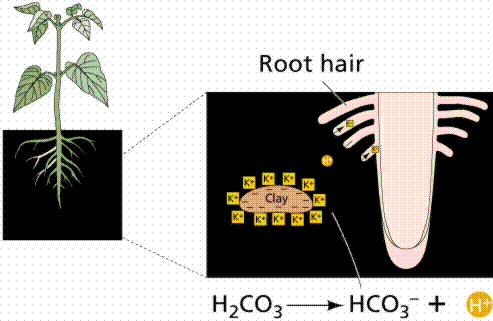
Strange as it may seem, the same processes that take place in our stomachs (and the same protections to keep toxins from entering the internal systems) are also essential to all plants. But plants, of course, do not have stomachs. Or do they? Yes they do. For a plant its stomach is the top-soil in which it grows. The enzymes and bacteria and other micro-organisms that break down the whole foods in the soil and make it available to the plant as basic nutritional elements all exist in the soil, external to the internal operational and metabolic systems of the plant. A large proportion of these organisms cluster in the small zone of soil immediately around the plant's roots (the root zone). Many of these organisms (specifically enzymes) are generated by the plant itself and released into this root zone. Here they interact with other soil organisms and supply "digested" and purified nutrients to the roots of the plants. But the soil organisms are not contained only within the plant's root zone. They exist throughout the top soil.

Those soil organism responsible for breaking down soil nutrients into a bio-available form that plants can absorb, unlike the digestive organisms in the somewhat protected environment of your stomach, are exposed and vulnerable to the environment in, above and around the soil in which they function. Here they are vulnerable to all of the injustices that man inflicts on the soil. They are exposed and destroyed when we cultivate the soil. Most importantly, however, they are destroyed (overstimulated and burned out) by the artificial fertilizers we put on the soil to improve our artificial soil fertility and, critically, destroyed in large numbers by the petrochemical pesticides we use to destroy insects attacking our crops. Most of our long-use commercial agricultural soil is, for all practical purposes, dead. The crops grown on them primarily are critically dependent on those artificial fertilizers for their nutrition and survival. Take away those artificial nutrients and those soils will, until natural fertility is restored which will take decades, probably only produce 10% of the crops we currently produce on them.

This is where peak oil and peak fossil fuels becomes so critical. Once supplies of those fossil fuels (most specifically oil and natural gas) begin to decline and the feedstock go into decline for those artificial fertilizers derived from natural gas, and those pesticides, herbicides and other agrochemicals derived from oil, we will have at least a temporary (for several decades) global soil fertility crisis. Our global ability to produce the food necessary to support our massive human population (which has nearly tripled in the years since the beginning of the Green Revolution) will decline rapidly and critically.

Even if, as the latest cornucopian CERA report claims (with which I vehemently disagree), peak oil is thirty years away, we need to have already begun the long-term process of restoring natural global soil fertility and transitioning from artificial soil fertility back to natural soil fertility. We cannot feed the current global human population today. The global emergency grain reserves have declined over this past decade from a marginal 119 day supply to a sub-critical 57 day supply and continue to decline as the world population continues to consume more food than is being produced. As much as one quarter of the global population today is malnourished or undernourished. The FAO estimates that 40,000 people globally are dying every day from starvation and nutrition-related diseases.

We need to stop quibbling over the details of how much fossil fuel reserves we have left and when the date of peak oil will be and accept the reality that some time in the near term future we will pass peak and start on the downhill slope. To mitigate the impact of that event we need to have already begun preparing for the transition that will then have to take place. To wait until we can verify that we have passed peak oil condemns the global human population to have to deal with the worst implications of that event.

Friday, November 17, 2006

Oil is oil, right? Wrong! All oil is NOT created equal.

There is considerable latitude for the average person to misunderstand the urgency in the peak oil message. Much of that centers on the obfuscation, misinformation, and disinformation by the different parties in the debate through disguising the statistics by lumping together apples and oranges (not to mention bananas, pears, pomegranates and kumquats) and not defining how many apples of each there are.

All oil, like all fruit, is not the same. There are, in fact, hundreds of different grades of oil ranging from the highest quality "light sweet" crudes to the poor quality heavy, high-sulfur crudes. And each grade of crude requires unique refining parameters and has its own individual price. Some cornucopean "energy analysts" lump into their definition of oil; tar sands, oil sands, oil shale, gas to liquid, coal to liquid and even bio-fuels.

The grades of crude you see reported in the news are known as 'marker' crudes. They are West Texas Intermediate (WTI) from the United States, Brent Blend from the UK North Sea and Dubai, or Fateh, crude from the United Arab Emirates. These are all intermediate to light-sweet crudes which are the most sought after grades. The problem is, however, that in recent years, the production levels of all marker crudes have fallen. Dubai, in fact, has fallen drastically. The proportion of heavier and sourer (higher sulfur) crudes changing hands in the oil spot and futures markets has grown relative to light sweet production. More than half the world's produced oil today is heavy and sour in quality and this proportion is expected to increase as new discoveries of light sweet crude continue to diminish and older wells get sucked dry of light sweet and are left with only the heavy sour crude on their production downslope.

The problem is that the world can't just switch from one to the other. "Heavy, sour" crude is more complex and costly to convert into useful products such as gasoline and heating oil. Tar sands, oil sands and oil shale are not oil at all but rather a bitumen precursor that is "mined" rather than pumped. And much of the world's refining capacity, particularly in Asia, simply can't process these poorer grades and precursors. "There's no shortage of crude oil today," says Thomas D. O'Malley, chairman of Premcor Inc., a refiner based in Old Greenwich, Conn. "There is a shortage of light sweet."

We do not yet have a crisis of oil supply. We have a crisis of quality. We have a growing crisis of refining capacity appropriate for the grade of crude increasingly available. Not all refineries are capable of handling heavy sour crude and very few can handle bitumen precursors. The shortage of refining capacity for current grades of crude is most acute in Asia, the very market where crude oil consumption is growing fastest. And throughout the world very little new refining capacity, relative to demand, is being built which will be able to handle the heavy sour crudes and bitumen that will soon effectively be all that is available. A clear bottleneck is emerging.

As the world is increasingly faced with having to make do with poorer grades of crude and product from tar sands and oil shale, the problem of satisfying world oil demand will no longer be the size of the remaining reserves. The extraction and processing problems, cost and time will become the bottleneck. Particularly when it comes to oil and tar sands and oil shale, you can't simply dig more wells in a field to increase production. As these are mining operations, the foot print for a single production site is measured in square miles, not square feet like with an oil well.

As you read various news items and reports, all I can suggest is you look very, very carefully at what is being defined as oil. What you think is Florida oranges may well be total global fruit production. Not very helpful if you want to produce orange juice.

Internet references

http://www.businessweek.com/magazine/content/04_46/b3908079.htmhttp://www.washtimes.com/business/20050313-114327-7447r.htm
http://www.econbrowser.com/archives/2005/08/sweet_and_sour.html
http://www.gasandoil.com/goc/news/ntn44964.htm
http://www.valero.com/Visit+Our+Refineries/Port+Arthur
http://www.financialsense.com/editorials/gue/2006/0407.html
http://www.platts.com/Oil/Resources/News%20Features/crudeanalysis/index.xml

Thursday, November 16, 2006

Is there any alternative to Powerdown? And the sooner the better?

How can there any longer be any question that peak oil will occur in the relatively near future? Even one of the most persistent and officially-appreciated cornucopeans (Cambridge Energy Research Associates or CERA, and its founder and leader, Daniel Yergin), despite the fact that their latest ridiculously expensive report (at $1000 a pop) claims to debunk peak oil, concedes that oil will peak within the next 25 years and go into decline within 50 years. Even for CERA, therefore, it no longer seems to be a question of if but rather when.

The big difference between CERA, in this latest report, and ASPO (the Association for the Study of Peak Oil) centers on the amount of unextracted oil remaining in the world. ASPO's estimates for the global production peak are based on an original endowment of 1.92 trillion barrels of oil. The CERA projections are based on an endowment of 2.93 trillion barrels of conventional oil and a total of 3.61 trillion barrels including unconventional oil like tar sands, and oil shale.

Does it really matter who is right? I totally discount CERA's numbers but does it matter, in the end, whether they are right or wrong? The simple reality is that both the optimists and the so-called doom-n-gloomers believe the global oil production will peak some time in this next quarter century.

Our current societal infrastructure has evolved for hundreds of years. More importantly it has been transformed into its present structure over these past two centuries thanks to our profligate use of fossil fuels and mineral resources. Tokyo, Nagasaki, Hiroshima, Berlin, London, Dresden and many more cities have been risen from the ashes and rebuilt since the end of WWII. But that was over sixty years ago.

The physical and social infrastructure that are going to be needed as we proceed down the decline slope of global oil production are going to be as different to that of today as our current society is from that before the industrial revolution.

It took, based on ASPO's global oil estimates, the first have of our oil endowment and 200 years to transform society from pre-industrial to the present. It will take the last half of our oil endowment to retransform society from that which presently exists to a post-industrial, post-fossil fuel structure. Even an optimist of the first order cannot possibly believe that that process will be sufficiently under way by the time we reach peak oil that we can complete the job before the remaining fossil fuels are, for all practical purposes, depleted. And yet that is exactly what must be done.

If we are to avoid social chaos, or at least a worsening of the social chaos that now exists, and if we are to avoid a massive human die-off (it is estimated that the maximum human carrying capacity without fossil fuel inputs is 2-billion people) on the post-peak downslope, we will have to put in place before that time the foundations of the infrastructure that will have to sustain us when the fossil fuels eventually run out.

I personally see no alternative before us other than now beginning a voluntary powerdown with a massive reduction in our global fossil fuel usage and, most particularly, our fossil fuel dependence. Anyone who underestimates the amount of work it will take to transform our society to one that can survive and be sustainable without fossil fuels is living in a dream world.

It's time to stop the arguing and name calling. It is time to stop the oil and resource companies from spreading the lie, directly and indirectly through organizations like CERA, that there is no problem ahead, that technology will save the day, that there are untold resources yet to be discovered and exploited. That is, as Energy Bulletin has defined it, peak-oil prozac and they are doing no one good by continuing to supply it.

Face reality.

Refuse the prozac.

Move on.

Monday, October 23, 2006

Plants With Stomachs - Peak Oil Implications


Feedback that got on a recent presentation of mine has, most unfortuntely, reminded me that the average person does not even a basic understanding of natural plant nutrition. Nor do they understand what soil fertility is, or what affects soil ferility. Most importantly, and this is where it is unfortunate, people generally do not understand the dire implications for our future global food security if we pass peak oil and head down the downslope of oil depletion without first taking strong remedial action to restore soil fertility, most particularly on those soils that have been used for commercial agriculture over this past half century.
How do plants get their nutrition and what nutrition do they need? I am guilty of having thought that was a simple question to which most people would instinctively know the answer. I was so very wrong.
Plants, of course, get their air from the same place we do.... from the atmosphere. But they, of course, do not breath air to get oxygen. They are after the carbon dioxide and after they are finished with they "exhale" oxygen, the direct opposite of ourselves. Does the destruction of the Amazon rain forest affect our global air quality? You bet your ass it does. Does it affect the build-up of greehouse gasses that is contributing so heavilly to global warming? Absolutely. Does it affect the nutritional quality of those plants we grow for food? Most people do not seem to realize that it does. The more carbon dioxide there is in the atmosphere the more plants will grow. To so many that is a good thing. The unfortunate reality is that the nutritional content by volume that results from that extra growth is going down steadilly. The other little understood reality is that, just as pure oxygen is toxic to our systems, the higher the concentrations of carbon dioxide in the atmosphere the more injurious it is to many plant species. They have, after all, evolved in an environment with a very tight range of CO2 concentration in the air they breath. When the concentration is outside those limits they can't cope with it any more than we can.
Plants, for the most part, get their water from the soil in which they grow. One of the key properties of naturally fertile soil is its ability to hold water which is then available to the plants growing in it. That water retention facility is a result of organic matter and humus in the soil. It is also a function of size of soil particles and the population of micro-organisms in the soil. Soil depleted of its organic matter and humus, soil where critical micro-organisms have been killed by pesticides and other petrochemicals, loses its ability to retain water. We compensate by irrigating those crops. This further exacerbates the problem by leaching critical nutrients, most particularly minerals, down into the sub-soil, and by building up toxic salts in the top soil that are injurious to both the micro-organisms in the soil but also to the plants grown in it. Those plants, for example, that extract nitrogen from the air and fix it in the soil are seriously affected by these toxic salts. The bacteria responsible for building the nodules on the roots of these plants wherein the nitrogen is held are very adversely affected and killed by the build-up of soil salts. No problem. We simply add nitrogenous fertilizer to the soil to make up for the inability of these soil organisms to fix nitrogen from the air. These heavy concentrations of inorganic nitrogen, however, simply make the problem worse over time because neither the soil organisms or the plants can cope with the overload.
Some of the most interesting feedback and discussion I received following my presentationwas about my point that, unlike ourselves and other animals, the mouth, stomach and digestive system of plants is not inside the plant but is, in fact, in the soil in which the plant grows. We eat whole foods which are broken down into discrete nutrients by the bacteria, enzymes, and other micro-organisms contained within our stomach and other parts of our digestive tract. Nutrients enter our bloodstream in pure form after being broken down. For plants all of that activity takes place in the soil. In healthy soil there are millions of these "digestive" micro-organisms for ever cubic inch of soil. A majority of them, in fact, live in a narrow zone surrounding the roots of the plants, and nowhere else. They break down and convert the organic and mineral nutrients in the soil into a form that the the plants can utilize. Pouring on chemical fertilizers is an extremely inefficient way of trying to feed plants. It still requires enzymes and bacteria in the soil to transform the nutrients into a bio-available form and make it available to the plant's roots. A great deal of the fertilizer introduced synthetically never gets taken up by plants. It either builds up to toxic levels in the soil or gets washed away into our rivers and lakes to pollute them. We continue to use more and more artificial fertilizer on commercial agricultural soil every year and yet our crop yields continue to decline. I have seen figures, and I can't validate them, that we are using 33 times as much fertilizer per acre today than just 35 years ago and yet are faced with crop yields of 20% less or worse.
The point in this rant is this. The green revolution championed by Doctor Norman Borlaug, which is based on the use of petrochemicals, irrigation, and high-yield hybridized anf GMO seeds, allowed us to head off a serious human calamity being brought about by overpopulation last century. Through the green revolution global food grain production more than doubled over this past half century. The problem is that the global population increased in the same time by an even greater percentage. Once we pass peak oil and agrcultural petrochemicals become, at first, increasingly expensive and then increaingly unavailable, the artificial fertilty that our use of petrochemicals has allowed will be lost and we will have to return to a dependence on natural soil fertility. The problem then is that the natural soil fertility on which we will then rely does not exist. We have destroyed it over this past half century. It will take at least two decades to restore that natural soil fertility no matter what method we use. With our artificial soil fertility gone and our natural soil fertility decades away, global food production capacity will fall to dramtically low levels. Naturally fertile soil, properly managed, can produce significantly higher polyculture crop yields than chemically dependent monoculture. The only problem is there is so little naturally fertile soil left on which to do it.

Thursday, October 12, 2006

Presentation at Oct 11 peak oil forum in London On

PEAK OIL IS NOT ABOUT THE OIL!

Introduction
That's a damn fool thing to say.
Of course peak oil is about the OIL!
But it is about so much more.
The real importance of peak oil, to me, is not about the gasoline to run your car, SUV, van or pick-up, your motor-home, motorcycle, moped, lawn mower, or your power boat, houseboat, ATV, snowmobile, sea-doo or skidoo.
And it's not about fuel for ships, planes, jets, tanks, trains, tractor trailers or heavy equipment.
Despite the fact that it is the highest single usage, our production of the gasoline that runs our cars is only about 40% of our overall oil usage, or about 10% of our overall energy usage.
If we eliminated all personal vehicles and the gasoline to power them, still 20% of America's remaining oil usage (America consumes 25% of all oil used in the world) would have to be satisfied from crude oil imports.
If we replaced every car on the road with an electric car, and limited future production to electric cars, our overall percentage of energy usage for personal transport would increase, not decrease.
Electricity production would have to more than double to power a fleet of electric vehicles equivalent to gasoline powered vehicles on the road today.


If Peak Oil is not about the oil, What is it About?
Suppose you woke up tomorrow morning, picked up the morning newspaper and found yourself staring at a big, bold, red headline which said;
OOPS, SORRY! WE WERE WRONG! THE OIL IS ALL GONE!
I'm not suggesting there is even a remote possibility of that but.... What would be the biggest impact?
Not being able to get any gas for your car?
Having to forget about that Carribean vacation this winter?
Being twenty blocks from the nearest mall?
That there will be no more HD TVs and you didn't buy one yet?
The biggest single impact of that reality would be F O O D ! !
Think about it;
* No more pesticides to keep insects from destroying our crops,
* No more herbicides to keep aggressive weeds from overrunning our fields and gardens,
* No more fuel for irrigation pumps to water crops to keep them from shrivelling up with the advance of global warming,
* No more fuel to run the tractors and equipment that farmers need to; till the soil; plant crops; weed crops; harvest crops;
* No more fuel to; deliver the crop to the co-op; deliver it from there to a processing plant; process the crop into "food"; refrigerate the food in storage; deliver the food to a distributor; refrigerate it at the distributor; deliver the food in refrigerated containers to your local food store; keep the food refrigerated at your local supermarket; run your car for the trip to the supermarket to buy food; refrigerate that food fresh when you get it home; power your stove and oven to cook that food.

We can ultimately do without cars, without HD TVs, DVD players, CD players, computers, electric woks, microwave ovens, electric fry pans, power lawn mowers, hedge trimmers, leaf blowers, power tools, etc., etc., ad infinitum, ad nauseum.
Many people will be convinced that they cannot but eventually, of course, they will have no choice.
B U T . . . . . . . .
You absolutely cannot do without food, without water, without breathable air, and without some protection from the elements.
Those are the basic necessities of life.
The ultimate impact of peak oil is this.
We have, in the last two centuries, made the availability of these essentials of life dependent upon oil and the energy that we derive from it and other fossil fuels.
And upon a global, perpetual growth economic system that is itself dependent upon cheap and plentiful oil and other fossil-fuel-derived energy.
Our food is totally dependent on oil and other fossil fuels from the time the ground is plowed to receive the seed to the cooking of that food in our homes.


The Misplaced Focus of the Peak Oil Debate
It is very difficult to get people's heads out of the gas tank when we talk about peak oil.
If we do not, however, we will not understand the real seriousness that peak oil represents for global human society.
Yes, peak oil will seriously affect the amount of fuel and energy available to run our society.
But let's accept that as a given, move on to the more serious issues.
The continued obsessive focus in the peak oil discussion/debate on the energy aspects of oil is like a drug addict going into a methadone treatment program.
It keeps us focussed on the energy addiction rather than changing our focus to planning and building for a life beyond that addiction.
Methadone is an alternative drug plan for the addict.
In order to continue to feed our oil addiction, or the energy/fuel underpinnings of that addiction, we continue to thrash around for alternative fuels through which we can continue to support our addiction "when the good shit is all gone"!
Because that is what oil is, the most flexible energy-dense fuel we have ever discovered.
Energy being the central focus of the peak oil discussion, in my opinion, turns the average person off hearing or listening to the peak oil message.
In so doing, it keeps them ignorant of the most serious consequences of peak oil and the decline in global oil supply to follow.

More important, keeping the peak oil debate focussed on energy keeps the rules of that debate stacked in favour of the economists and "energy experts" who argue;
* that peak oil forecasts have no validity,
* that peak oil forecasters are a bunch of wing-nuts,
* that we have enough oil left to last for centuries.
Just recently the head of Saudi Aramco claimed that there is enough oil left in the world to last another 140 years. The ex head of Exxon/Mobile recently claimed there is oil enough left to last several centuries.
Perception is reality.
In the mind of John Q. Public, the CEO of Exxon or the head of the USGS or the head of Saudi Aramco or Daniel Yergin of CERA or George W. Bush and Dick Cheney themselves are all considered to be THE Energy Experts,
not Colin Campbell or Ken Deffeyes or Kjiel Aliklett or Jean Lahererre or Jeremy Leggett or Senator Udall or Richard Heinberg, and certainly not me.
There are only a few voices from inside the oil industry that are speaking out honestly about peak oil, people like Matthew Simmons and Ali Samsam Baktiari.
If we keep the peak oil debate focussed on the energy component of oil and other fossil fuels we place ourselves squarely in the position of having to attempt to discredit the cornucopean and socially acceptable opinions of all of these recognized experts in the eyes of the public.
That's not going to happen!
The nucleus of the peak oil debate always has been and always will be, until after it has become reality, on the timing of peak oil.
When will the peak be?
The answer to that question has always been, nobody knows!
We won't know global production has peaked until some time after it happens, and it will still be debated for some time after that.
In 1971 "energy experts" crowed that Hubbert's Peak Oil forecasts were rubbish because America was producing more oil than they ever had before.
And, they would soon find, more than they would ever produce again!
The problem with the timing of peak oil and our response to it, as was clearly outlined in the Hirsch Report that was commissioned by, delivered to and shelved by the U.S. Government, is that it will take us decades to prepare the infrastructure needed for a viable and sustainable post-fossil-fuel society.
It will also take most of the energy available in the remaining global fossil fuel reserves to effect those changes in infrastructure.
If we wait until peak oil is upon is - there are many who argue that it already is - to begin to make these changes and if we attempt to maintain business as usual right to the bitter end, it will indeed be the bitter end.
If the preparation of the infrastructure needed for that future supportable/sustainable society has to compete for energy and other oil-derived materials with a still "driven" global growth economy, there simply will not be enough left to get the job done.
Nor will there be the social, political, business and industrial motivation to concede the need for infrastructure change and divert the fuels needed to sustain that growth economy into projects that are a clear concession that global economic growth is on its last legs.


Carrying Capacity: Global Food is Dependent on Oil
Peak oil is about 6.75 billion human beings dependent for their food and survival on a petrochemical created and supported artificial carrying capacity, about petrochemical dependent global agriculture, about a petrochemical dependent global food distribution system.
Peak Oil is about our ability to feed ourselves.
It is about an estimated non-fossil-fuel-supported "real" global carrying capacity of 1-2 billion people.
It is about how we move food around the world to feed those 6.75 billion people. On any given day there are millions of tons of food products on the move around the world.
It is about grapes and tomatoes in January, ice-cream in July, Canadian bacon and pancakes and maple syrup in New Zealand and New Zealand spring lamb, kiwi fruit, tamarillos and macadamia nuts in Toronto and London, and about the energy use that makes all that happen.
There are no nuclear-powered, solar-powered, wind-powered or hydrogen-powered refrigerated food ships on the high seas.
There are no nuclear-powered or hydrogen-powered 747s flying tomatoes up from Chile in February.
The Oshawa Food Terminal in Toronto doesn't have its own nuclear power plant.

Whether we like it or not, our food production, processing and distribution system is global and it runs on oil, not just for transport but for planting, harvesting, storage and processing.
Our food, the most critical essential of all human life on earth, is dependent on a single finite commodity that is about to become more scarce with every passing year, a resource that will run out some time during the lifespan of our grandchildren or great grandchildren.
Or maybe within the lifespan of our own children.
That the global supply of oil will eventually run out if we continue to consume it is an absolute certainty.
That we will have to learn to live without oil and the other fossil fuels is an absolute certainty.
That the social infrastructure around us will have to change before we run out is an absolute certainty IF we are to mitigate the worst of the impact.
As the old Fram oil filter commercial said, "you can pay me now or you can pay me later but it'll be a lot more expensive later".


Decline in Global Food Production
Peak oil is about a continuing diminishment in our global food production capability and global food security while our population continues to grow.
Over the past ten years there has been a net reduction in the global food grain production.
The global food grain crop has gone down in each of the last three years and will continue to decline because of;
* grain-crop land now being increasingly converted to the more profitable production of ethanol crops,
* grain production increasingly diverted to the feeding of meat animals as global meat consumption per capita increases,
* continuing decrease in available grain-crop land as large tracts of that land are taken out of production due to soil loss, rising soil toxicity, growing salination due to over-irrigation,
* continuing degradation of natural soil fertility due to the overuse of chemical pesticides and herbicides.
According to the UN, over the past several years the global emergency food grain reserves have diminished from a marginal 119 day supply to a sub-critical 57 day supply, and continues to decline because we have produced less grain over the past decade than is being consumed.
With the bulk of the world's grains for export being grown in the northern hemisphere, the bulk of the world's arable land being in the northern hemisphere, the bulk of the global desertification being along the equatorial boundary, and the bulk of the world's grain importing nations being along the equatorial boundary or in the southern hemisphere, when the global grain reserve dips below the critical level of sixty days it is no longer a question of total annual grain production against demand.
The timing of that production and the timing of the demand becomes a critical factor.
Too much of the global demand occurs during the months in which the northern hemisphere is not producing new grains to replace that being consumed.
Already there is a risk, at certain times of the year, that freshly harvested grains combined with grain reserves cannot meet the constant demand
The further the reserve level drops the greater the number of people placed at risk of starvation.
Sufficient global food production will be the most critical and urgent global geopolitical problem over these coming decades.
Food will increasingly become a weapon of war.
Food will increasingly be the biggest lever used in the negotiation of trade agreements between countries and regions.
One of the first changes made in Iraq following the U.S.-led invasion was to flood the country with patented seeds from companies like Monsanto and Cargill and bring in laws under the newly-elected puppet government against the millenia-old practice of seed saving.
The idealist in me believes that control of field crops and the seeds that grow them should not be placed in the hands of multinational corporations,
that the simple change or insertion of some obscure, recessive gene into the genome of a plant should not allow right of access to that plant or seed to be "owned" under patent by any organization.
The idealist in me believes that the right to grow food must remain a universal human right not to be usurped by corporations.
That right will become ever more critical as we pass global peak oil.


Unsupportable/Unsustainable Global Urbanization
Peak oil is about 6.75 billion people increasingly concentrated into severely fossil-fuel dependent, ever-growing, concrete-and-steel urban/suburban enclaves,
each a high-tech, virtual world cut off by concrete, steel and asphalt from the natural world that sustains it,
a world in which the majority of people have never seen the food that they eat growing in the garden or the field.
200 years ago, as we began our move fully into the fossil-fuel age, less than 10% of the human population, or about 75-100 million people, lived in cities, less than a handful of which exceeded 1 million population.
In the last decade we have surpassed 50% urbanization globally or about 3.5 billion.
While our global population has risen about 7 times during these ten generations of the fossil-fuel age our urban concentration has increased forty fold!
At the beginning of the fossil fuel age there were just a few cities over 1 million population. Now there are hundreds, and several over 20 million.
The Golden Horseshoe, a continuous expanse of urbanization stretching around the west end of Lake Ontario from Oshawa to Niagara, is home to nearly eight million people.
There is more concrete and asphalt in the golden horseshoe than in the rest of the province combined.
Imagine, if you will, how a city the size of London will function without oil and other fossil fuels like natural gas and coal......
In my book "Oilephant Down" I included a small segment called "every day" in which I tried to detail the amount of oil-dependent activity that takes place in a city of a million people in a single day.
Most of the feedback I have had on the book mentions that segment and how disturbing it is (most readers being city dwellers) to think of that and the impact on all of that activity as the global oil supply diminishes.
The simple reality is that large cities are neither supportable nor sustainable without oil.
They would not be even with the type of community infrastructure characteristic of pre-industrial society.
Before the fossil fuel age there were, in all of history, fewer cities of one million population than there are in Canada today.
Those cities depended upon large amounts of energy in the form of slave labour, complex irrigation systems, complex road and water transportation arteries, and the growing and organized storage of extensive food crops within the city itself.
There is one other very important difference between large cities before the industrial revolution and those today.
Those cities occupied and grew within horizontal space, usually with integrated food production space growing right along with them.
Our cities today are stacked vertically, concentrated in a density never approached by those ancient cities.
Our open ground between structures has been covered over with concrete or asphalt or converted into manicured lawns.
This adds a level of energy dependence (vertical) that those cities in historical times never had to contend with.


About Soil Fertility
Over the past two centuries we have all but abandoned the discipline of soil science in favour of artificial chemical soil productivity.
We no longer concern ourselves with the biological complexity of soil.
If we want to produce and retain more crop we just dump on more natural-gas-derived artificial fertilizer,
spray the crop with more oil-derived herbicides to keep down the competition from weeds,
spray the crop with more oil-derived pesticides to keep the bugs and other insects away,
and irrigate the crop, using fossil-fuel derived energy, to make up for the lost moisture-holding ability of the sterile soil on which we grow the crops.
For all practical purposes our commercial agricultural soils serve no more purpose than to hold the roots of the plant in place.
I spoke before about estimates that the earth's true carrying capacity without fossil fuel support is 1-2 billion people. Those are not my estimates nor do I particularly agree with them.
On a global basis, as a result of the Green Revolution, the global crop yield has been increased dramatically over this past half century.
Unfortunately, in the same time, the global population has more than doubled.
Yet there are countless examples around the world where crop yields on small plots, without the aid of artificial chemical inputs, have been dramatically higher than those achieved in large scale, chemically-assisted monoculture.
Properly managed with natural organic methods with absolutely no artificial inputs there are many examples where a family of four can produce enough food to support themselves on as little as an acre.
Properly managed and supported the soil has tremendous natural fertility that today's methods of commercial agriculture cannot come near duplicating.
The problem is this.
Our commercial agricultural soil, at least in North America and Europe but probably throughout the world, has been raped of its natural fertility.
If we take away the artificial life-support system that we have those soils on, the patient will die. Those soils have no fertility left.
To understand why, one must understand what natural soil fertility is and how it works. Then one can see how our modern farming methods have destroyed it.
Plants, like ourselves, to survive need clean air to breath, clean water to drink, food to eat, and protection from climatic extremes.
The air they get from the same place as us. One big difference, though.
We animals breath air for the oxygen and then we exhale carbon dioxide.
They breath air for carbon dioxide and then exhale oxygen.
A very nice symbiotic relationship.
The water plants need they get primarilly from the soil in which they grow with some water absorption through the leaves.
That brings us to the food plants need.
Where does that come from? A bag of 23-10-5 (or whatever the numbers are) NPK fertilizer?
Plants get the bulk of their nutrition from the soil. But how?
Do they have little mouths under the ground and physically eat the dirt?
Well, surprisingly, the answer to that is sort of..... yes!
Plants receive their food, and most of their water, through their roots, just like we do through our mouths. There is one major difference, however.
We eat whole foods. Then bacteria, enzymes and other micro- organisms digest and break down those whole foods in our stomach into their component parts of vitamins, minerals, proteins, fats, starches and sugars, then pass the waste parts through our digestive tract and.... well, never mind the rest.
Plants don't have stomachs, at least not in the same sense as we do, in which to "digest" their food, nor bowels and bladders for disposal of wastes.
In a large sense the plant's stomach is the soil.
The micro-organisms that break down the soil into nutrients in the form the plant can use exist outside the plant, in the soil, many on the outside surfaces of the plant's own roots.
The microorganisms convert, for example, raw minerals in the soil into a bio-available oxide form that plants can utilize. They then make them available to the roots of the plant.
The waste products of that process are expelled by those micro- organism back into the soil.
What nutrients do plants receive from the soil?
Primarilly minerals.
The cells of plants, like all living organisms, are made up of a full spectrum of minerals and other basic elements like hydrogen, nitrogen, oxygen, and so on.
The most important mineral for plants, as for ourselves, is carbon - the basis of life on earth - but most minerals are required, the majority in minute trace amounts.

How have we destroyed soil fertility?
How is natural soil fertility destroyed by modern farming methods?
* First, and most important, critical soil microorganisms are destroyed by pesticides.
* The organic content of the soil, necessary for retaining moisture and for supplying carbon to the plants, is not replaced in the soil with the application of organic matter in the form of manure and compost.
* Vast amounts of living top soil are lost every year through wind erosion and water erosion.
* Tilling and harvesting with heavy equipment form an impermeable hard-pan 6-8 inches below the surface of the soil that blocks the ability of the soil organisms and plant roots to reach nutrients deeper in the soil.
* This hard pan prevents soil organisms from migrating below the frost line for the winter.
* Irrigation leaches critical mineral nutrients out of the top soil down through the hard pan where they are no longer available to plant roots.
* The top soil becomes increasingly toxic with the build up of salts from over irrigation. Each year thousands of acres of farmland in North America are taken out of production because the soil is too toxic to produce crops.
* Constant turning of the shallow top soil destroys the soil humus which binds the soil together, and kills many anaerobic soil microorganisms by exposing them to the air.
* Nutrients extracted from the soil in crop harvesting are exported from the farm and are not replaced except for the NPK in commercial fertilizers.
* Fall tillage brings microorganisms from deeper in the soil up to the surface where they may be killed with the onset of winter.

Rebuilding natural soil fertility
Rebuilding natural soil fertility will require redressing injustices that we heap on the soil, particularly the life-supporting top soil, for that soil to become productive again after we are forced to abandon modern farming practices on the downslope of Hubbert's Peak.
That effort could take several decades.
If we wait until we are forced into it with the decline of our ubiquitous agricultural chemicals we will face a period where the productivity of our soil drops well below both the current level allowed by those agrichemicals and the level of the natural soil fertility that we will have to achieve.
In other words, unfortunately, the longer we wait to start moving toward natural rather than artificial fertility, the greater the risk that the carrying capacity will temporarilly drop below the sustainable level.
Briefly, we need to;
* Repopulate agricultural soils with critical soil microorganisms,
* Break up the impermeable hard-pan below those soils,
* Restore a full-spectrum mineral balance to food producing soils,
* Restrengthen topsoil with adequate organic matter and humus,
* Adopt agricultural practices supporting good soil management,
* Move away from broad-acre monoculture farming practices,
* Implement alternatives to soil-compacting heavy equipment,
* Develop non-chemical methods of pest and weed control,
* Develop aggressive composting schemes to return organic matter to the land from which crops are harvested,
* Revitalize the use of manures and compost to restore fertility and soil organic content,
* Rebuild moisture-holding capability of soil instead of irrigation.

Global Food Distribution: Isolation from Source of Food
Peak oil is about the ever-increasing miles of separation between 6.75 billion human beings and the food upon which they depend for survival.
200 years ago, at the start of the fossil fuel age, people grew the majority of their own food.
What they didn't grow was acquired within five miles of home and was produced by someone they knew by name.
Today, the food on your table has travelled an average of 2500 miles, has been through dozens or perhaps hundreds of pairs of strangers' hands.
You probably do not even know the grocer from whom you buy your food.
Any food produced in an area will only be consumed in that area by chance, and will have travelled at least hundreds of miles from farm to co-op to processor to distribution centre to the local supermarket before it arrives back on local tables.
A critical requirement following peak oil, ideally beginning now, is the relocalization of the food supply.
The food eaten locally should be grown and processed locally.
That's a simple statement but a tremendous geo-political and economic hot potato.
Grocery stores and supermarkets do not acquire their food from local growers and producers.
In fact stores of food chains are generally contractually obligated to NOT acquire their product locally.
And that situation will continue until either public pressure or legislation forces it to change.
And it's not just a local problem. The local municipal government cannot, on its own, take control of and change that situation. They cannot bring in local legislation requiring food stores within their jurisdiction to acquire their product locally. That's not where the control rests.
Much of the control and legislation impacting the ability to relocalize the food supply exists at the provincial level, some at the federal level.
Food is required, generally under provincial legislation, to be channeled through co-ops, inspection agencies and marketing boards.
Even the control of what a farmer can produce is controlled at the provincial level.
It is provincial legislation and regulation that prevents that local farmer from selling his produce locally.
So the process of relocalization of the food supply is going to require an unprecedented degree of cooperation between different levels of government.
That's going to take time, commitment, and a tremendous amount of effort. It's also going to require the visible and vocal public demand for and support of these changes.

Consumerism and Finite Resource Depletion
Peak oil is about a global "consumer" society created by and still extremely dependent upon cheap, energy-intensive fossil fuels.
We have over 300,000 products in our daily lives made from oil or oil derivatives, all of which have travelled an average of 5-6,000 miles before arriving in our homes.
The parts that make up that new Japanese car you buy may have collectively travelled more miles before being assembled than that car will ever travel after you buy it.
We each throw away or discard more reusable materials in a single year than any one of our grandparents would have used in a lifetime.
The products we buy today are a product of "planned onsolescence" designed to be used and usable only until the next model comes out and then to be thrown away and replaced.
That's what consumerism is.
We no longer "use" this planet's vital non-renewable resources.
We "consume" them, use them and throw them away.

Unsustainable Global Growth Economy
Peak oil is about a global economy totally dependent on perpetual growth which is in turn totally dependent on the energy derived from cheap and abundant fossil fuels.
They are no longer cheap or abundant and never will be again.
What multinationals do not achieve in real growth they gain through virtual or apparent growth,
through movement of inventories and capital (for many poor nations over 60% of their foreign trade is inventory transfer out of the country) amongst globally dispersed operations (much of it for tax avoidance),
and through the aquisition of smaller, weaker competitors (very often for the simple purpose of eliminating competition by shutting them down).
Most multinationals are so highly debt-leveraged to support competitive acquisition and merger that they need a minimum of 2% "real" annual sales growth just to service their debt.
Sales gained through acquisition come at the cost of even more debt.
Acquisition is for the appearance of growth for the corporation to be able to attract continued investor cash injection.

National Sovereignty over internal resources
Last, and certaily not least, peak oil is about the ability of a people or a nation to exercise sovereignty over the remainder of its energy and other resources in order to manage and control them in a future of diminishing and eventually depleted energy resources.
We no longer do.
Canada is the only country under the current NAFTA agreement that has abandoned its sovereignty over its own energy resources.
Mexico didn't and the US sure didn't.
And, because of the probable carryover, Canada may be the only country that would do so under the proposed, but fortunately embattled and delayed, FTAA.
Hugo Chavez in Venezuela sure as hell won't, nor Bolivia, Ecuador, Brazil nor, probably any other South American or Carribean country.
Paul Celucci, the former US ambassador to Canada has even recently suggested that access to our fresh water resources should be written into the NAFTA agreement.
Peak oil is not about the oil. It is about;
* peak food,
* peak carrying capacity,
* peak technology,
* peak manufacturing,
* peak mobility,
* peak population,
* peak globalization,
* peak water,
* peak civilization,
* peak pollution,
* peak species extinction.
Through the use of the energy density of oil and other fossil fuels we have taken more out of this planet than we ever should have been able to achieve.
Now it is time to see if we can live and survive with the results of our ingenuity.
The issue is not the oil!
The issue is the impact of what we have done with it...... and what we will do without it.
May God be with us. We are going to need all the help we can get.

Monday, October 02, 2006

Peak Oil and Overpasses

I know it is a dangerous game to link every piece of news to peak oil. You will have to forgive me for stepping into this one. Over this past weekend there was a collapse of an overpass in Laval Quebec, a suburb north of Montreal. Two cars were flattened by the collapse killing five people. I was not surprised, have been expecting this sort of event to start occuring on a regular basis. And I expect it to be more so as we pass peak oil and start on the downslope on the other side of Hubbert's Peak.

People often point to the economic collapse of the Great Depression and say we got through that one and we'll get through the next one. Society didn't fall apart. The ubiquitous overpass is one very major difference between now and then. In this past half century the overpass has become as common as overflowing refuse containers on city streets. They are everywhere. I will be journeying to London Ontario in a week and a half and I will be driving under at least a hundred overpasses on that trip.

Canadian highway infrastructure, especially those bridges and overpasses, will be severely tested on the other side of peak oil. And the reasons are fairly simple.

* It is probable that highway maintenance will decline for lack of funds, or privatized off to the lowest bidder.
* Our weather extremes take a tremendous toll on highway infrastructure, that being one of the major reasons for our high maintenance costs. Extremes of temperature constantly expand and contract the bridge structure causing stress fractures in the concrete and even in the rebar.
* Our obsessive overuse of corroding salt on our highways takes a heavy toll, especially on bridges, overpasses, and elevated sections of highways.

If one looks at the chain of events in the Laval overpass collapse you can see these future problems dramatically. Over an hour before the collapse the roads department was called by citizens reporting chunks of concrete falling from the overpass on to the roadway. A roads crew showed up at the site, picked up the chunks of fallen concrete and left (they have since claimed that they were going to request an inspection later). An hour after the picked up those fallen pieces the whole one side of the overpass collapsed. That overpass was only 36 years old and was designed to last for sixty. And this was the second overpass collapse in the same area.

Welcome to peak oil highways.

Tuesday, September 26, 2006

Peak oil and Optimistic Pessimism


On one of the online peak oil forums in which I actively participate there are several members who rejoice as they enthusiastically bring to the group every new pronouncement from the secret land of the energy fairies. This is done with the drive and verve of a snake oil salesman who has just received a new shipment of bottle corks. One could be kind and assume that this is done to bring balance to the discussion in the face of such an overwhelming mass of doom-n-gloom pessimism. And their certainly is a reasonable amount of that around. But, in my mind, that is wholly reasonable. Most of the forum members who are posting messages are relatively new to the concept of peak oil. As such they are overwhelmed by the implications of peak oil and, when they understand the deepest of these implications, quite frankly most of them are frightened, desperate, and find little solace as they look at the geopolitical world around them.

As each of these new whiz-bang energy alternatives is discussed it becomes increasingly clear that none of them is going to be able to offer any serious mitigation to the problems global society will face on the downside of Hubbert's Peak when the global oil supply can no longer keep pace with global demand. The simple reality that we all sooner or later come to terms with is that oil has been the most energy intensive fuel source this planet and our species has ever seen or will ever see. And when peak oil newbies, as they are affectionately called, fully understand the depth of our total societal reliance on oil despair often replaces former denial, even if only temporarilly. The constant reaching out for salvation from the energy fairies is largely seen as just another form of denial. The constant expression of relief at every new alternative energy development project or every new piece of new technology that promises unprecedented energy efficiency is generally viewed as the cruelest of false hopes.
Our forum members who so enthusiastically revel in every new positive piece of energy news, probably understandably, tend to view the generally negative reception of such news as doom-n-gloom. They tend to categorize those who reject these pieces as doom-n-gloomers or trolls. "Who," they ask, "doesn't want society to be able to carry on as long as possible." These techno-fix members do not accept that their wish, their hope, and their endless pursuit of sustaining techno-fixes in ultimately short-sighted in the extreme. This is largely based on the fact that they see energy supply as a problem in isolation. They choose not to consider the extreme damage that we have done to the environment and the extreme psychological damage that we have done to the human species as part of the problem of which peak oil is but a very dominant syndrome. They tend to reject reminders that, at least for the past half century, global agriculture and our ability to feed ourselves has been totally based and dependent upon fossil fuels. They tend to reject reminders that our everyday world is made up of over 300,000 products made from or derived from oil, many of those products themselves critical to the efficient and effective running of global human society. They reject reminders that the current social infrastructure has been built with the first half of the world's oil endowment and that it will take that second half of our oil reserves to rebuild the infrastructure into a sustainable post-oil model.

What these techno-fixers see as pessimism and doom-n-gloom is, in fact, an optimism and expression of hope, a hope that we will soon peak and start the slide down the other side in order to force us all to have to come to terms with eventual depletion and start working on developing the society in which we will have to live on the other side of depletion. There will be tremendous pain on the road to post-oil sustainability and most in the peak oil movement want to get on with the preparation. Any pessimism is based on the frustrating reality that current society has so many serious roadblocks to being able to get on with that preparation that even peak-oilers, despite their being fully aware of what is to come, cannot prepare properly because of those roadblocks. Yes, their pessimism is based on the belief that TPTB will do everything in their power to maintain the status quo as long as possible, regardless of the downside results of that effort. Their pessimism is based on a strong belief that the effort will be far too late and far too little, despite the fact that we have known for at least a half-century that the game would soon be up.

Those who see and understand the full implications of peak oil do not want to see an endless procession of new alternative energies and techno-fixes designed to maintain the status quo as long as possible. Yes, they take mild pleasure in seeing these things shot down. Not because they want to see disaster unfold on the other side of peak oil but because they realize that the longer we wait, the longer we prolong an unsustainable human societal model, the greater will be the unavoidable disaster on the other side. They want to mitigate the worst of that inevitable disaster, not worsen the situation by holding off any longer.

Friday, September 15, 2006

Relocalization and Retail Food Chains

One of the most important and critically necessary social adjustments to peak oil is relocalization of food security. Today the food on your tables has travelled an average of 2500km to get there. The dishes and the table on which they sit and the various equipment and tools involved in the preparation of that meal on the table have travelled an average of over 6000km to get to your home. The food production and distribution system on which you depend to feed yourself and your family has become a truly global system which is critically dependent on oil and other fossil fuels.

Even over these past several years the energy costs imbedded in that global food system have risen dramatically. There are periodic cost respites, slight dips in a steadilly increasing cost upslope. But even at this stage we are a long way from peak food cost. We will probably look back at these times of expensive food as the "good old days." The reason, of course, is that peak oil and peak food cost are not synonymous. If we arrive at peak oil still totally dependent on a global food system then peak oil is the starting point for an exponential rise in food costs that will turn food into a luxury item.

We cannot continue, over the long term to be so critically dependent on a global food system that is going to falter under the weight of future skyrocketing oil prices. And in this case the long term will probably be measured in years, not decades. If we are to feed our families as we slide down the downslope on the other side of peak oil, the cost of food must become the cost of food. The greater the energy cost component there is in that food, based on distributing it around the world, the more the cost of food is going to follow the rising cost of energy as oil moves toward depletion. Relocalization of the food supply, so that the food on your table is produced (including grown) within 100 miles of you, is the only realistic and sustainable way to take the energy cost out of your food costs. The food in your local grocery store/supermarket must increasingly come from local suppliers, local growers, local processors, local co-ops.

Ideally the bulk of the food on your table would be grown and processed and preserved by you, either on your own land or as part of a local gardening co-op. There are, unfortunately, many legislative hurdles in the way of this happening in urban areas on a large scale. That will remain the case until local municipal governments adopt a stance supportive of peak-oil preparation and undertake the process of changing municipal codes to re-orient towards mixed agriculture/residential zoning and move away from the fixation on manicured lawns. This will take time and probably will not occur in most municipalities until the reality of peak oil is glaringly obvious and the voters are not only receptive to such changes but demanding them.

In the interim, however, much of the relocalization could be accomplished through your local grocery store or supermarket acquiring the food on their shelves from local producers and processors. Though that would make a tremendous contribution to local food security, it is not going to happen under present practices and policies. Most food retailer chains are contractually obligated to their current food suppliers. This help them keep their prices down, at least helps them keep their costs down. Whether or not those cost savings are passed on to customers is another issue.

A key part of the contractual arrangement with the chain's suppliers is the issue of exclusivity or market share. The chain store is contractually obligated to buy certain percentages of their shelf stock from that supplier, to place that stock in specific shelf locations at specific heights with measured distance from particular competitors. A key part of that market share obligation that the food retail chains must commit to is to not acquire product from local growers/producers. The food crops produced by the local farmers basically cannot be sold into the local community but must be channeled into the food processing/distribution system through which it may eventually, but probably will not, make its way back into local food stores.

Probably the most critical challenge in relocalization of the food supply, therefore, is to be able to undo the contractual agreements that prevent local food retailers from independently acquiring their product from local growers and producers. This will probably require a serious amount of local public pressure. It may also require municipal governments to require local food retailers who wish to sell food within their jurisdiction to acquire a certain proportion of their product (a proportion that should increase over time) from local producers and suppliers.

Such changes would, initially at least, probably increase the local cost of food. This will be partly artificial but most certainly partly real. The retailer would, through these changes, lose much of their advantage of volume buying. But as the global oil and energy costs grow and the energy cost component in the food supply grows, the energy cost advantages of local supply will begin to kick in and the growing costs of food out of the global food system will surpass local costs and local supply will become an advantage. Over time it will become a critical necessity as well.

Tuesday, September 12, 2006

Peak Oil Methadone

The problem with Methadone treatment for drug addiction is that it keeps the focus on the addiction, through the use of an alternative, rather than shifting the addict's focus to preparing for and building a life for after the addiction. The problem with keeping the focus in the peak oil debate/discussion on the energy component of oil and trying to find alternative fuels to replace the energy derived from oil is that it keeps the addicts (all of us) focussed on the addiction rather than developing a new paradigm for life after the oil to which we are addicted is no longer available at a level that that addiction can be supported.

As long as we allow the peak oil dialogue to stay focussed on the energy issues we are playing right into the hands of the pushers who are feeding that addiction. We allow debunkers an easy target to focus on by promising all of those existing and potential energy sources. They offer ethanol which, like any good addict, allows us to continue to put out good money for the next fix rather than considering how to put food on the table. In a world that cannot produce enough food to feed our 6.5+ billion population with billions of dollars of oil-derived petrochemical inputs, we turn to ethanol to support our addiction at the expense of taking vital food producing land out of the food production system. The global emergency grain reserves over the past several years has dwindled from a marginal 119 day supply to a sub-critical 57 day supply. Global grain production has fallen below global grain usage in each of the past three years and will probably continue to decline while the population continues to rise.

The pushers feeding our addiction offer us coal to liquid (CTL), natural gas to liquid (GTL), tar sands and oil sands and oil shale, electric cars, hybrid cars, all to continue our addiction rather than offering methods of kicking our addiction and moving on with an addiction-free life.
We can not cure our addiction by continuing to substitute new alternatives in support of that addiction. At some point we have to get refocussed. The longer that takes, the more difficult it is going to be and the greater the number of casualties that will result.

Kick the habit.
Bypass the methadone.
Get clean.
Move on.

Thursday, September 07, 2006

Chevron's "Jack 2" Deep Water Oil Discovery


So much hype over nothing! Give me a break. CNN, Fox, CNBC, and any other news outlet in North America have been all over this thing for the past 2-3 days. Why?
Chevron's "Jack Two" well is a "new" deep water well in the Gulf of Mexico in a field that "could" hold between 3 billion and 15 billion barrels of oil. They won't know exactly how much oil is down there until they drill more wells to get a true measure of the reserve. The reserve is a total of 28,000 feet down beneath about 7,500 feet of water. Chevron expects to be able to deliver crude from the well to market by 2010.
If absolutely everything about this "discovery" (it was actually discovered in 2000) is the best they could hope for, this whole field may be able to be pushed to deliver up to 500,000 barrels a day some time after 2013 from 100 or more wells.
But let us look at some hard realities.
Generally about half of the oil in a reserve is ultimately recoverable which, if the estimates are for the total reserve size, would mean that 1.5 to 7.5 billion barrels may ultimately be recoverable.
The oil is 28,000 feet down which will require tremendous amounts of energy to get it to the surface. It may even mean that it takes more energy to extract the oil and get it to a refinery (meaning a negative EROEI) than it ever produces in energy.
The well and the field are in the deep waters of the Gulf of Mexico, hurricane alley. And being that far offshore in deep water it is very possible that they will not be able to deliver that crude to shore by pipeline, therefore having to have a tanker-loading facility on the platform. Any tanker being loaded would not be able to make a successful run for shore with a rapidly developing, unpredictable hurricane bearing down on the gulf. Even if they could deliver the crude to shore by pipeline, we have seen the tremendous destruction that can be inflicted on underwater pipelines by a hurricane like Katrina or Hugo.
Even if 15 billion barrels of oil can be extracted from this reserve, that represents less than two years of US demand and only 6 months of global demand. And it won't start to be delivered antil 2010 or later.
There is also a small technical geological issue involved here. It has generally been understood that the viable oil production zone goes down to somewhere between 15-20,000 feet. This is the deepest production well that has ever been drilled. No one knows how the production dynamics of such a deep well will play out. It may be that only a quarter of the oil down there, or less, is ultimately recoverable. The potential of applying technology like water injection or gas injection or lateral drilling on such a deep well are extremely limited. Once well pressure drops and production falls off wells on such a reserve are going to have dramatic and rapid production drops.
All in all, therefore, this "discovery" ain't no Ghawar. It is far too little far too late to make any impact on the long term global crude depletion curve. Sure is good for a November election though.

Wednesday, September 06, 2006

Peak Oil And Global Warming Do Not Fit Socially Believable Disaster Profile

No explosions. No volcanoes. No earthquakes, tsunamis, landslides, floods, tectonic upheaval, no buildings falling. No hurricanes, cyclones, tornadoes. No cinematic special effects, pyrotechnics. No dramatic, heroic rescues. Just a long, slow, grinding, debilitating, dehumanizing, hungry slide into...... nothingness.
The combination of the social destruction of peak oil and the ecological destruction of global warming and climate change could, over this next century, kill more people than ever existed on earth prior to the last century. Together they could reduce the human population to a billion or less, force the remainder to gather together into a few narrow pockets of ecologically and climatically sustainable regions.
To be honest, we have no idea how these two devestating forces are going to play out. The greater part of the human race are urban dwellers, living in a virtual world of technology reliant on incredible amounts of continuous energy for its very survival. We have disconnected ourselves from the land, from the real natural world that sustains all life on this planet, the only world that will eventually be left to us when the energy that sustains our technological world diminishes and eventually disappears and our urban enclaves begin to crumble about us.
How do you show people a long, insidious catastrophe like that? How do you compress the next couple hundred years into a ninety-six minute movie to make it visible? What special effects can possibly show people what this future is going to be like? How can we possibly show people what it is they need to see to understand what lies ahead and which compels them to prepare in order to even be able to survive the collapse and have a chance to be part of the rebuilding.
I know this is rather apocalyptic, but that's the mood I'm in right now. It happens every once in a while.

Homestead or Community?


There is a common thread running on three of the peak oil groups in which I participate that is at the heart of much of the duality within the peak oil movement. These threads are discussions on an article by Rob Hopkins in early September in Energy Bulletin. The article is entitled "Why the Survivalists Have Got It Wrong." The whole article can be found at http://www.energybulletin.net/newswire.php?id=20051.
This article illustrates an unfortunately common misconception of the peak oil movement and, specifically, of peak oilers. That misconception must, in my mind, betray a lack on understanding for the author of the article. It is as though the author is aware of peak oil (the article is, after all, in Energy Bulletin, one of the most trusted information sources for peak oilers) but knows absolutely no one "involved in" the peak oil movement.
The article starts from and stays with the premise that peak oilers are "run for the hill survivalists" who all adhere to a philosophy of building their own isolated, wilderness survival homestead, totally cut off from any involvement with or sense of responsibility to any community. I have addressed this issue before in other articles. The huge flaw in the argument presented in this article, however, is a perception that peak oilers arrive at this strategy by choice, by first choice in fact. Therein lies the betrayal that the author would seem not to know any peak oilers, at least not well enough to understand their motivation.
No peak oiler that I know, whether on the various forums I am involved in or personally, has as their first choice running off into the wilderness and disassociating themselves from community. Most "seasoned" peak oilers arrive at this option out of frustration after years of being considered a nut case, years of fruitless attempts to warn those around them of the coming danger. Eventually most peak oilers reach the point where they feel that if no one wants to listen, if no one wants to see the danger ahead and start to prepare, then to hell with them. There's too little time to prepare without wasting it on people who adamantly do not want to listen.
In every peak oiler's failed efforts are attempts to motivate community into preparation. This is with the clear recognition, to most, that the only viable survivability must be community based. Clearly individual preparation and the abandonment of and isolation from community is not their prefered approach.
Even though pursuing personal preparation is where most peak oilers end up, most still do so with the belief that sooner or later the wider community will "get it" and when they do the isolated, prepared peak oiler will be there to assist, to train, to educate, to organize. Most believe that when the community is ready, meaning the community ceases to be an impediment to preparation, they will reinvolve themselves with that community. I have an old saying that I think says it best; "The right idea at the wrong time is the wrong idea."

Tuesday, September 05, 2006

Ethanol/Bio-diesel VS Food

Thrashing about for an alternative source of energy to support business as usual as the global supply of crude oil goes into decline more and more energy companies, university research projects, and governments are turning to the enticing spectre of ethanol and bio-diesel. Increasing acreage of industrial agriculture soil around the world is being converted to the production of corn, soy, sugar cane and any other crops intended to be diverted into the production of motor fuels. There are serious proposals as well for the production of motor fuels from wood, from coal, from natural gas, and from seaweed.
All of this is coming about because the love affair with hydrogen that has been passionately engaged in for the past couple of decades has fizzled out in the face of hard geothermal realities, like one of those many moonlight kisses that cool in the morning sun. Hydrogen, even the most ardent supporter eventually accepts, is only an energy carrier, not an energy source. It takes energy to produce hydrogen and store it and convert it back into an energy bundle, and more often than not those working on hydrogen fuel options are facing the realization that it takes more energy to produce and convert hydrogen than the energy derived from the hydrogen itself.
The very important and sad bi-product of this new love affair with ethanol and bio-diesel is that it is severely impacting, and going to increasingly impact, our ability to feed and support even the existing human population, let alone support the ongoing increases in that population. For six of the last seven years the world has produced less grain crops than the world has consumed. The amount being produced has declined for each of the past three years. The world's emergency grain supplies have, over this past few years, declined from a 119 day reserve to a reserve level below the danger level, currently 57 days. And it is believed, by all reputable agronomy scientists, that global grain production will continue to decline as global warming, environmental pollution, soil toxicity, soil depletion, global aquifer depletion, fresh water contamination, and soil salination continue to exacerbate the problem.
As I have said repeatedly, peak oil is not about the oil, not about motor fuels, not about running our cars and SUVs and vans and all the other fuel-driven engines. It is about our inability to feed a growing human population. We can not do it today. When we lose the increased crop production capability that fossil fuels have given us, when we lose the artificial fertilizers and pesticides and herbicides and other agricultural chemicals that have been the underpinning of the green revolution that has seen our population more than double in the past half century, there is going to be a tremendous nutritional deficit throughout the world.
We cannot continue to pursue our western lifestyle as we have when it comes at such a huge price to the near-term human population of this planet. Past failures of agriculture were always local and were responded to by finding new territory and starting over again. There is no new territory left. We cover this entire planet and the whole process of economic globalization should have made one thing perfectly clear to everyone. In a greater way than the global economy was a global societal benefit, the abundance of human created problems we are facing on the near-term horizon will represent a totally unprecedented global catastrophe.

Thursday, August 24, 2006

Shirley's Hands

Hands of solace to my child-felt pain,
Hands with music to play my song,
Hands of tolerant wisdom to read my words,
Hands of laughter,
Hands of love,
Hands of velvet,
Hands of steel,
Hands of labour,
Hands of rest,
Hands to hold the self in strong silent anguish,
Shirley's hands have felt
The full pulse of life,
Could hands be asked to do more?

Tuesday, August 22, 2006

An Argument Against Personal Peak-Oil Preparation

Most of those in the peak oil movement, and those not in the movement but who are aware of and "get" the serious implications of peak oil, are concerned with potential deterioration of society and potential anarchy and chaos on the other side of peak oil. It is a common situation that those who become aware of peak oil and understand the seriousness of it want to warn those close to them about the problems ahead. And it just as common that those same people, once rebuffed or labelled as a nut case, draw back and begin to quietly and unobtrusively focus on their own personal preparations. They do this in the belief, usually, that society won't wake up soon enough to prepare sufficiently to avoid the worst of what peak oil will have to offer.
I strongly believe that those personal preparations that people are making, even if they are correct for whatever peak oil scenario eventually unfolds, are not going to ensure their survival any more than making no preparations at all. In fact I strongly believe that the more successful their preparations appear to be in helping them survive the more visible a target they will become for those who have not prepared. Thieves don't invade the homes in poor neighbourhoods, they go up-town where the best pickings are.
That refocussing on personal preparations, that focussing on preparing yourself for survival regardless of what the community around you is or is not doing, is, I would argue, born of the same self-centredness that has broken down the fabric of our society and turned us all into cogs in the machinery of big business and big government. We no longer see ourselves as part of a community but rather simply residents within it. Our neighbours are neighbours by geographic proximity only.
There is a fairly simple split in the peak oil community regarding the method and model that people feel is best for surviving the fallout from peak oil. There is the live-off-the-land, lone-wolf, armed-to-the-hilt survivalist attitude of those who expect to be able to live in the wild by their wits alone, foraging and taking game as their sources of food, and satisfying all of their needs from nature. There is the go-it-alone homesteader attitude of those who think they can have a stand-alone, self-sufficient homestead on which they produce all of their food and satisfy all of their needs, very often assuming a nearby community from which to aquire those things they cannot produce themselves, that being a community, however, to which they feel no allegiance and for and to which they bear no responsibility. That community is there as a service to them.
Then there is the attitude of surviving within a community, a community that is interactive, inter-dependent, where all members contribute to that community and benefit from that community. It is this that is the closest to the normal psyche of the human animal. We are not lone wolves or individualistic wanderers. We are tribal, function best within a larger group, whether that is an extended family, a tribe, a village, a town, a bio-region or something larger (which I do not believe is ultimately workable in a post oil world). We are not all capable (if any are) of personally performing all of the tasks which ultimately are needed to ensure our long-term survival. Being part of a community allows different people to adopt certain skills and specialties in preference to others, specialization.
Community, the smaller the better, is, in my opinion, the only social modality that has long-term probability of survival success in a post-peak/post-oil world. Community is composed of people who know each other intimately and work together to satisfy their collective needs. It is a society of cooperation, not competition. It is a society of stewardship, not ownership. It is a society that collectively satisfies its combined needs, not one of building individual wealth. It is a society utterly foreign to the current North American mindset, a wholesale paradigm shift.

Tuesday, August 08, 2006

The Hydrocarbon Generations

Everyone alive today was born into one of the just twelve hydrocarbon generations since the onset of the industrial revolution late in the eighteenth century. One generation, statistically, is twenty years, that time between birth and the beginning of giving birth to the next generation. But real generations are not neatly separated by twenty year intervals like statistical models portray them. Right now there are people living who individually represent six generations. All of those people collectively are the present global human population. Over the period since the industrial revolution began the statistical relationship between generations and overall population have changed dramatically. One very important and overriding statistic is that in those twelve generations since the industrial revolution began the human population has increased sevenfold........ in just twelve generations!

At the beginning of the Industrial Revolution the total global population was, by best estimate, about one billion. For the purposes of this article that population of one billion will be used as a base. When the generation born at the start of the Industrial Revolution began to have children of their own twenty years later, their children were being born into a world with a little less than 10 percent more population than when they themselves were born. That generation increased the global by another 12 percent more than that at the time their parents were born. Each new generation being born today is increasing the global population by more than 1.5 times (150%) the base Industrial Revolution population. During the hundreds and thousands of generations before the Industrial Revolution and the advent of serious hydrocarbon use, the human population had been relatively stable or grew by fractions of a percent from one generation to the next.

At the beginning of the industrial revolution, just twelve, short generations ago, we began building a global human infrastructure not only geared to the use of hydrocarbons but increasingly and critically dependent on them. Just as each generation cannot imagine their parents having sex, each generation cannot imagine living without the benefits they derive from hydrocarbons that did not exist in their parents' time.

It is impossible to separate the current global population from the use of hydrocarbons such as oil, coal and natural gas, thus the reason I call the past twelve generations the Hydrocarbon Generations. The utter explosion of human numbers in these past twelve generations is, in fact, diretly a result of that increased usage of and dependence on hydrocarbon fuels. Our global infrastructure was not only built through the energy derived from hydrocarbon fuels but that infrastructure itself is increasingly composed of products derived from those hydrocarbons. There are today over 300,000 products in everyday use in our society that are made from oil or derivatives of oil.

The dramatic rise in human population since the industrial revolution began is not a result of an equivalent rise in the number of children a couple are producing. In fact the number of children given birth by the average woman of childbearing years today is less than half those that would have been produced by a woman before the industrial revolution. In the largely agrarian societies that existed before the industrial revolution it was common to have more children to serve as helpers and labourers on the family farm and to serve as a source of security in the parents' senior years. As industrial society grew, and particularly as it evolved into a high-tech society this past century, children increasingly became an economic liability and cost, rather than the benefit they had previously been. With these changes families opted for fewer children on each of whom much more economic benefits were lavished.

The sevenfold rise in human population over these past twelve generations has essentially been the result of one overriding factor, the improved health and medicine resulting from the increased benefits of hydrocarbon usage. Prior to the Industrial Revolution the average life expectancy was about forty years. It is now over seventy-two years. That means that at the outset of the Industrial Revolution the living human population consisted of 2 generations. Today it consists of more than 3.5 generations.

More importantly, people are on average not only living longer, but a far greater number of people born are living long enough to produce children. Prior to the Industrial Revolution child mortality rates were often as high as 75%. Globally, even in 1960, the child mortality rate was still 19.8%. By 2001 that had been brought down to just 8.3% globally. With an average rate of 6 live births per woman in pre-industrial agrarian society, possibly only two of those children would survive to child-bearing age. Of the 2-3 average live births per woman today, on average over 91% of those children will survive to child-bearing age. In pre-industrial times, however, a larger proportion of females born would end up married and/or producing children. Today, with improved medicine, high divorce rates, fertility medicines and procedures, and birth selectivity through which, in many nations, unwanted female children are aborted, the number of females born that will eventually produce children has increased signifigantly from pre-industrial times.

In these past twelve generations not only has the human population increased sevenfold but the per person hydrocarbon usage has increased even more dramatically, from virtually zero to an average of over five barrels per year per person of oil alone. At the same time that we are inexorably increasing our dependence on oil and other hydrocarbons we are dramatically increasing the rate at which we are using up these irreplaceable, very finite hydrocarbons.

Here is the ultimate, unavoidable, and disastrous implications of that increased consumption. It is reasonably, though arguably, estimated that the total global carrying capacity for the human species, without the availability of those hydrocarbons, is about 1-1.5 billion, roughly the population during the early decades of the Industrial Revolution. The increase in human population since then has been irrevocably a result of our use of hydrocarbon fuels. The infrastructure we have evolved over these past twelve generations has been built of and through the energy derived from those same hydrocarbons. The dramatically increased pace of consumption of these vital resources is pushing ever harder on the acelerator of the train that we are all riding toward the hydrocarbon cliff, the cliff beyond which nature will help us balance the books between population and real carrying capacity. I'll leave it to your imagination as to how we get from a global human population of nearly 7 billion to one of 1-1.5 billion that can be supported without those hydrocarbons.

Friday, August 04, 2006

Tar Sands Are Not A Solution


The closer we get to a global oil crunch the more longingly governments and oil companies are looking at tar sands, oil sands and oil shale deposits around the world. Many of those see such unconventional reserves as the hope of the future as conventional oil reserves slide further down the depletion slope on the far side of Hubbert's Peak. Canada, of course, has the Alberta tar sands. Venezuela has the Orinoco oil sands. The US, Australia, Russia and various other countries play host to large reserves of undeveloped oil shale.
The most extensive exploitation of any of these resources is in Canada's tar sands. Billions of dollars of investment have been pumped into the Northern Alberta economy in massive projects like Syncrude. But there are serious problems developing even here, and most certain to be repeated if similar exploitation of the world's other oil sand and shale reserves. Cost overruns on tar sands projects have ranged anywhere from 50% to 200-300% and more. Total have today announced a three year extension on their tar sands development, pushing the projected completion date out from 2010 to 2013, based on severe over-runs on anticipated development costs.
And what comes out of the tar sands is not oil! It is a precursor to oil which requires extensive and very expensive processing to even turn it into a low-grade crude which the majority of North American refineries cannot process. Tar sands processing, at this stage, depends very critically on natural gas as a processing energy source, natural gas which itself is in decline despite record investments in exploration and development. Various of those projects are looking at alternatives to the natural gas, including coal to liquid conversion and nuclear, as the depletion curve on our natural gas reserves accelerates.
The current rush of investment funds into Alberta's tar sands is being sunk into new projects that will, even by the most optimistic estimates, come on line anywhere from five to twelve years in the future. We have already passed the peak in global conventional oil production and are clearly on the downhill slide. Unless there is a tremendous global spate of new refinery development of the type of refinery that can handle heavy sour crude, a global peak in overall oil production becomes increasingly meaningless. If the world's oil producers are no longer capable of supplying the type of crude that the world's refineries can process, even a dramatic increase in production will mean nothing if it can't be turned into the gasoline, diesel and 300,000 other products that are today produced from oil and oil derivatives. We will, for all practical purposes, be well past "peak useable oil" long before the new tar sands projects come on line. Even if miraculously we can ramp up tar sands production to 5, 7, even 10 million barrels a day, it will be of the wrong grade of crude and will not come near offsetting the fall off in production of useable oil that will have occured by the time they do come on line.
Governments the world over are now finally starting to accept that we are facing a looming global oil supply crisis. That is a remarkable shift from the level of political awareness even 2-3 years ago. The problem is that all the political dialogue centres on where to turn for an alternative energy source to replace the energy lost as the global oil supply declines. Thus far governments are not daring to ask the only question that will prepare us for the energy deprived future ahead of us: "How to we reduce our energy consumption?" Alternatives are not the answer. They only buy us some time. We have known for at least a half a century that sooner or later the oil would run out. We have wasted that half century in an ever-increasing binge of oil usage. We have done nothing about a change of direction, developed and sold to the people any new paradigm, at least at the levels that would have any meaningful impact on the future problem. As long as governments continue the pursuit of a business-as-usual agenda, tar sands, oil sands, and oil shale will not be able to fill the void.