The greatest single issue in the whole gamut of peak oil issues is and will continue to be food security, global human society's ability to feed itself. This is inextricably linked to two other issues; 1) global human population and 2) soil fertility. Once we have passed peak oil and the users of that oil must compete for an ever-decreasing supply there are no guarantees, other than price and the market, as to who will get the supplies they need and who will be priced or simply pushed out of the market. If human population continues to grow at the same time and we continue to "invent" new ways of expanding our oil and other energy usage, the gap between that rising demand and that declining supply will continue to grow at a pace faster than the pace of oil decline.
In my opinion, the greatest single critical issue at that point will be food security and soil fertility. Since Doctor Norman Borlaug kicked off the euphemistically-titled Green Revolution a half century ago as a solution to the global malnutrition crisis, the human population has been living on an artificial soil fertility. This was created with and continues to be critically dependent on the use of artificial fertilizers derived from natural gas, petrochemical pesticides and herbicides, hybridized and genetically modified food crops, aquifer-depleting mechanical irrigation, and an energy-intensive and oil-dependent global food distribution system. When the fossil fuels on which this artificial soil fertility are dependent go into decline we are going to have to again rely on natural soil fertility to feed the 7-billion+ population that will then exist. We have, during this prolonged Green Revolution, been systematically destroying this planet's natural soil fertility. For more on this see the articles Plants With Stomachs: Peak Oil Implications (October 23), Presentation at October 11 Peak Oil forum in London ON (October 13), and Peak Oil is not about the oil (July 18) in this blog.
Let me try to put soil fertility in a context that most people will understand. How do living organisms on planet earth get the nutrients they require for building and maintaining body tissues and for the energy to drive muscles, nerves and other operational tissue? Put simply, how do plants and animals eat and digest food? They have stomachs, of course. The enzymes and bacteria and other micro-organisms in the stomach break down that whole food into the basic elements of nutrition [proteins (more specifically amino acids), vitamins, minerals, fats, starches, sugars]. They also perform the very important task of being the primary intercept for toxins so that they do not enter the internal operational systems of the organism. For this reason, and contrary to popular belief, the process of digestion takes place outside of those internal operational systems. The stomach (your stomach) where the digestion takes place is linked to but is not part of the internal metabolic and operational systems of the organism. Once the digestive enzymes and organisms have broken down the food in your stomach to basic nutritional elements, these elements are released to the intestine (still not part of your internal systems). Further, more specific digestion takes place in the intestines. Once that work is complete the wholly digested and primarily purified nutritional elements are released to the liver via the Hepatic Portal Vein. The final process of purification takes place in the liver and from there the purified basic nutritional elements are released and travel via the circulatory system (we are now in the internal systems) to those parts of the organism where they will be put to use. All of this movement of nutrients throughout the body is accomplished through the agency of tens of thousands of different enzymes.
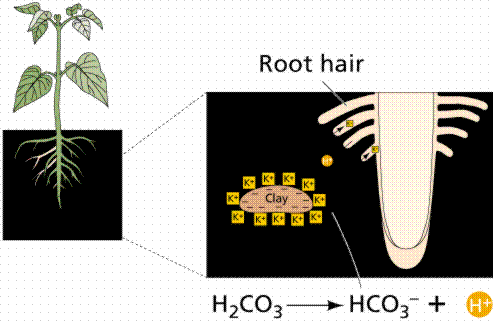
Strange as it may seem, the same processes that take place in our stomachs (and the same protections to keep toxins from entering the internal systems) are also essential to all plants. But plants, of course, do not have stomachs. Or do they? Yes they do. For a plant its stomach is the top-soil in which it grows. The enzymes and bacteria and other micro-organisms that break down the whole foods in the soil and make it available to the plant as basic nutritional elements all exist in the soil, external to the internal operational and metabolic systems of the plant. A large proportion of these organisms cluster in the small zone of soil immediately around the plant's roots (the root zone). Many of these organisms (specifically enzymes) are generated by the plant itself and released into this root zone. Here they interact with other soil organisms and supply "digested" and purified nutrients to the roots of the plants. But the soil organisms are not contained only within the plant's root zone. They exist throughout the top soil.
Those soil organism responsible for breaking down soil nutrients into a bio-available form that plants can absorb, unlike the digestive organisms in the somewhat protected environment of your stomach, are exposed and vulnerable to the environment in, above and around the soil in which they function. Here they are vulnerable to all of the injustices that man inflicts on the soil. They are exposed and destroyed when we cultivate the soil. Most importantly, however, they are destroyed (overstimulated and burned out) by the artificial fertilizers we put on the soil to improve our artificial soil fertility and, critically, destroyed in large numbers by the petrochemical pesticides we use to destroy insects attacking our crops. Most of our long-use commercial agricultural soil is, for all practical purposes, dead. The crops grown on them primarily are critically dependent on those artificial fertilizers for their nutrition and survival. Take away those artificial nutrients and those soils will, until natural fertility is restored which will take decades, probably only produce 10% of the crops we currently produce on them.
This is where peak oil and peak fossil fuels becomes so critical. Once supplies of those fossil fuels (most specifically oil and natural gas) begin to decline and the feedstock go into decline for those artificial fertilizers derived from natural gas, and those pesticides, herbicides and other agrochemicals derived from oil, we will have at least a temporary (for several decades) global soil fertility crisis. Our global ability to produce the food necessary to support our massive human population (which has nearly tripled in the years since the beginning of the Green Revolution) will decline rapidly and critically.
Even if, as the latest cornucopian CERA report claims (with which I vehemently disagree), peak oil is thirty years away, we need to have already begun the long-term process of restoring natural global soil fertility and transitioning from artificial soil fertility back to natural soil fertility. We cannot feed the current global human population today. The global emergency grain reserves have declined over this past decade from a marginal 119 day supply to a sub-critical 57 day supply and continue to decline as the world population continues to consume more food than is being produced. As much as one quarter of the global population today is malnourished or undernourished. The FAO estimates that 40,000 people globally are dying every day from starvation and nutrition-related diseases.
We need to stop quibbling over the details of how much fossil fuel reserves we have left and when the date of peak oil will be and accept the reality that some time in the near term future we will pass peak and start on the downhill slope. To mitigate the impact of that event we need to have already begun preparing for the transition that will then have to take place. To wait until we can verify that we have passed peak oil condemns the global human population to have to deal with the worst implications of that event.