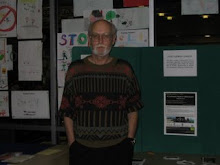
I have a confession to make. From time to time I feel seriously insecure about continuing to write about peak oil. Added to the constant awareness that people simply do not want to hear the message, that becomes a conflict for me. You see, I am not, nor have I ever been, an oil expert, a geologist, geophysicist or even a professional energy analyst. Hell, I don't even have a college degree, of any type, ended my "formal" education in grade 12. Like Richard Heinberg and Matt Savinar I came to the peak oil issue as an outsider looking in. It seemed to fit in with much about which I was already passionate.
I brought with me a lifetime concern about our gradual but obvious destruction of the environment, some early activism in that regard, a deep concern about our exponentially growing population and the limits to the earth's carrying capacity, deep angst and confusion over our belief in our entitlement to the earth's resources exclusive of the needs of other species, a deep concern over our destruction of soil fertility through our modern agricultural practices, an inquiring mind, a high degree of Mensa-level intelligence, a deep-seated and long-held concern and anger about the insidious influence and control corporations are exerting over our everyday lives and, particularly, over our governments. More importantly I brought an ability to write well with a balance of effective research, well thought out and reasoned argument and a deep feeling of passion. But I often wonder if all of that is enough.
The crux of my concern is this. There are many good writers out there on the subject. To a large degree we are all writing the same thing, feeding off each other and on common data, all drawing the same logical conclusions from that data. They may not say things in exactly the way I would but, so what?
My uncertainty, derived from a lifelong battle with a never-overcome inferiority complex, develops generally when I read a highly technical piece from one of the peak oilers who is an oil geologist or geophysicist. Not only could I not write the piece they did, half the time I struggle to understand what the hell they are talking about. It would be no less understandable if it were written in Swahili. And then I get angry because I realize it is the same thing all over again that I encountered when I was twenty-one. So please bare with me and let me explain that incident in order to clarify.
At twenty-one I was a computer programmer analyst with two years experience under my belt already. Our IS department's office was an open design with individual cubicles. It also had very poor acoustic design. You could hear every conversation in the whole office. Overhearing those discussions I grew agitated because I was stuck working on simple jobs while those around me, based on what I was hearing, were getting all of the nice, complex problems to work on. Most were college graduates which I assumed, and reluctantly accepted, was the reason they were given the more challenging assignments. Finally I summoned the courage to confront my boss on the issue. I told him I could handle tougher assignments like my co-workers were getting and I felt they should start to assign me to some of them.
I was totally crushed when he laughed in my face. Until he explained why.
"Believe me," he said (forgive my paraphrasing but I don't remember the conversation exactly after forty years), "but you couldn't be more wrong. If I get something complex across my desk, something new that needs some ingenuity and innovation, it goes straight to your desk. Those guys you are referring to complicate the simplest jobs and hide behind jargon when they talk about it. They create complexity where none exists. You go straight to the heart and essence of it, take complexity and make it simple, and get on with the job, and do it in half the time they would. And you explain things in English, not computereze."
That was an incredible life-lesson for me. I realized then that there is a tremendous difference between communicating and communication. The responsibility for the recipient's ability to understand rests squarely with the person doing the communicating. Communication rests not on the act of communicating but the method. If the recipient cannot understand then communication has not taken place and, therefore, the act of communicating has been wasted. My ability to understand a complex problem is of absolutely no value if I cannot help others to understand what I have understood. A man with the intellect of Einstein is only important insofar as he can communicate to others what he knows and help them to understand it. It was a responsibility I willingly assumed for the rest of my life.
That having been said, that is the reason I keep writing about peak oil. The essence of the peak oil issue, which is constantly lost in discussion and arguments about field reserves and oil grades and rates of extraction, is this. Peak oil is not about the oil!!!! So many of those involved in the peak oil discussion have not grasped that simple truth. That is the forest that is hidden by the trees.
The peak oil discussion and debate too easily and too frequently degenerates into a discussion about the price and availability of gasoline for the family car. That gasoline is only one of over 300,000 products insidiously integrated into our everyday lives. Oil is not only the energy that sustains our society's mobility. It is the physical structure of our society, the raw material for all of the plastics in our homes and offices and the infrastructure of our communities, the synthetic fibers with which we clothe ourselves, the chemicals on which agriculture has become hopelessly dependent for growing the food that sustains us, the drugs and pharmaceuticals responsible for our health and our lives, the ubiquitous additives and preservatives in our processed foods, the cleaning products under the sink, the asphalt on our roads that lets us speed around aimlessly from place to place. It is not just the source of the fuel in your car, it is the raw material from which most of your car is built.
Life as we know it, as virtual and disconnected from the natural world as it is, exists only because of oil and the other fossil fuels. The obvious corollary is that life as we know it cannot exist without oil and the other fossil fuels. Put another way, and a message that no one wants to hear, the end of oil is the end of the world as we know it! People tend to react violently to the first part of that statement; "the end of the world," and completely miss the last part, "as we know it" and yet the first part is not true without the qualification of the second part. Put another more palatable way, the end of oil means that things are going to change..... big time.
Peak oil is not about the oil! It is about what we do with the oil. And primarily what we have done with the oil is build up a critical dependence on it in more ways than the average person can even see or understand. As you read this look around the room in which you are sitting. Ask yourself how many of the things in that room are not partially made from oil or derivatives of it. How many of those things could be made from other materials and function as they do? How many were made close enough to you that they could get to you without oil-dependent transportation? And most importantly, how seriously would it change your lifestyle if they were not there?
There was a TV commercial running over this past winter pushing the role the chemical industry plays in our everyday lives. During that commercial everything made from or dependent on chemicals in the fabrication were gradually removed from the house. What struck me about that commercial was that everything that disappeared was made from oil and its derivatives. The chemical industry of today is essentially a petrochemical industry. It was a perfect picture of our dependence on oil and the things that will begin to disappear from our lives as we pass peak oil. And the family car and the gasoline in its tank weren't even part of the picture.
That is why I continue to write about peak oil. I continue to hope that I can be a part, however small, of getting average people to understand the depth of their dependence on oil in order that they can begin to understand the depth and breadth of the changes that will occur in their lives when we pass peak oil and head down that downslope. I also hope to convince them that those changes are going to be critical enough that they need to view skeptically those who glibly promise them that there is no problem, that we've got enough oil to last for centuries, that the American way of life is not negotiable. As Richard Heinberg says, if your way of life is not negotiable you need a new negotiator.
Monday, April 16, 2007


Thursday, April 12, 2007
Animal poop in a virtual world
God! We are such idiotic animals. It's like that old wrap-around theory that says genius is just one step away from insanity. Maybe it takes an animal with intellect to be as stupid as we. Perhaps we'll never know, unless we have visitors for dinner from Alpha Centauri.
How did we reach the point where everything that's good for the soil and contributes to its ability to support life is considered waste by our species, to be replaced with obviously superior, man-made crap, artificial fertilizers, chemical pesticides and herbicides, genetically modified plants designed by man? We cut the hay from the field, feed it to the cows in a barn, scoop up their shit and drop it on a big festering pile at the end of the barn for the rain to wash bits of it into the streams and rivers or to sink down through the soil into the aquifers.
For millions of years nature recycled all of the excretia from all of the animals and enriched and built up life-supporting top soil. Then we come along and strip it off the land to build a new sub-division of houses on the bare, sterile sub-soil and go out to a garden centre and buy a load of sod (which comes complete with a whole half inch or inch of top soil to replace the half-foot or foot we stripped away) to put over it and then fertilize it (because we've killed all the micro-organisms in it) with NPK because everybody knows that's all plants need.
Sorry about the rant.
The city council in my nearby city (Toronto) are debating a new by-law this week. It epitomizes the extent of stupidity in our modern society.

It is a very popular past-time in Toronto (I don't know about other cities but I assume it is the same) to take the doggy to the park for a run with all his other doggy friends. Toronto has a poop-and-scoop bylaw so owners are expected to pick up their doggy droppings or, as our politicians euphemistically call it, pet "waste".
Those politicians are now upset because 26% (not 25, not 27 but 26.... I wonder who counted) of the "waste" in park waste receptacles is "animal waste". The new bylaw will require pet owners to take their "pet waste" home and put it in their own garbage. This while the city has in the past year implemented a "green bin" recycling program where householders can put their compostable waste out at the curbside in a green bin (right next to their bag of grass clippings).


Does anybody else see a huge disconnect here? Is it any wonder that our soil fertility is shot when animal poop is considered "waste"?
How did we reach the point where everything that's good for the soil and contributes to its ability to support life is considered waste by our species, to be replaced with obviously superior, man-made crap, artificial fertilizers, chemical pesticides
 and herbicides, genetically modified plants designed by man? We cut the hay from the field, feed it to the cows in a barn, scoop up their shit and drop it on a big festering pile at the end of the barn for the rain to wash bits of it into the streams and rivers or to sink down through the soil into the aquifers.
For millions of years nature recycled all of the excretia from all of the animals and enriched and built up life-supporting top soil. Then we come along and strip it off the land to build a new sub-division of houses on the bare, sterile sub-soil and go out to a garden centre and buy a load of sod (which comes complete with a whole half inch or inch of top soil to replace the half-foot or foot we stripped away) to put over it and then fertilize it (because we've killed all the micro-organisms in it) with NPK because everybody knows that's all plants need.
Sorry about the rant.
The city council in my nearby city (Toronto) are debating a new by-law this week. It epitomizes the extent of stupidity in our modern society.

It is a very popular past-time in Toronto (I don't know about other cities but I assume it is the same) to take the doggy to the park for a run with all his other doggy friends. Toronto has a poop-and-scoop bylaw so owners are expected to pick up their doggy droppings or, as our politicians euphemistically call it, pet "waste".
Those politicians are now upset because 26% (not 25, not 27 but 26.... I wonder who counted) of the "waste" in park waste receptacles is "animal waste". The new bylaw will require pet owners to take their "pet waste" home and put it in their own garbage. This while the city has in the past year implemented a "green bin" recycling program where householders can put their compostable waste out at the curbside in a green bin (right next to their bag of grass clippings).


Does anybody else see a huge disconnect here? Is it any wonder that our soil fertility is shot when animal poop is considered "waste"?
Monday, April 02, 2007
Alternative Energy, Add-ons and Replacements
It seems one cannot deal with the subject of peak oil without getting drawn into the peripheral discussion of alternative energy. That whole discussion, however, is full of misunderstanding, misinformation, disinformation and the source of a significantly dangerous false sense of security. One of the most common counters to the characterization of peak oil as a global crisis is a cornucopean belief that as the oil declines we will bring on-stream alternative energy technologies to replace those pushed to the sideline by the oil decline. People point to hydrogen, nuclear, geothermal, wind energy, wave energy, tidal energy, solar energy, bio-fuels, garbage-fuels and more. One or some combination of them will fill the gap, the optimist declares, and business and life will go on as usual.
The average person, when they hear the term "alternative energy" interprets that to mean "replacement energy". The reality, since the beginning of the Industrial Revolution has been quite different. The reality has been that every new energy source "discovered" has been treated as an add-on to the existing energy portfolio, not as a replacement of it.
 There is, to begin, a common misperception that the fossil fuels (oil, natural gas, and coal) were "discovered" in the past couple hundred years. That displays hubris akin to a fundamentalist interpretation of the Bible claiming God created the world during some week in 4004 B.C. There is archaeological evidence that coal was used in the Bronze Age over 5000 years ago. There is a debated theory, based on archaeological evidence, that coal was used as a fire fuel as long ago as the Stone Age. Natural gas was the fuel that fired the eternal flames in the Ancient Greek

 Temple of Rhodes and the Temple of Vesta in ancient Rome. Oil in the form of tar and asphalt was in use as much as 3000 years ago. In 4th century China there were oil wells as deep as 250 metres, that oil transported over considerable distances in bamboo
 pipelines and used to evaporate sea water to get salt. In ancient Japan oil was called "burning water". Even many of what we call alternative energies have been in use for centuries. Water power was the primary source of energy for much of "industry" during the middle ages.(1) Wind power in windmills and sails goes back thousands of years. Passive solar has been used extensively in many cultures for a variety of purposes. Geothermal energy was employed in Hawaii and by the Maori in New Zealand as long ago as biblical times. Ethanol and bio-diesel predate our modern day usage of both oil and natural gas. Various forms of oils derived from plants have been used for lighting, cooking and heating for thousands of years.(4)
What changed starting at the outset of the Industrial Revolution was the amount of energy being employed by society because of the growth of industrialization. Coal usage in Britain in 1700 before the Industrial Revolution was about 2.5 million tons per year. By 1900 it had grown by a factor of a hundred to over 250 million tons per year.(2) By 2000 global coal usage had risen to 4-billion metric tonnes a year. During the 20th century overall global energy consumption grew from 0.7 terrawatts to over 15 terrawatts in 2004, an increase in energy use of 2142% and an increase of over 640% energy use per capita.(3)
Coal usage in Britain, for example, did not replace the use of wood for fuel before the forests of Britain and Ireland were wiped out, though it could have been used to save what forests remained. In fact, though coal was already significantly in use when the forests were essentially depleted, British demand for wood as a fuel continued with demand being satisfied by expensive imports from the colonies and from continental Europe.
When oil, in the early twentieth century, began its rise to its position of dominance in the global fuel mix, polluting and less efficient coal was not abandoned. The growth in coal demand slowed for a while but over the course of the 20th century, while the population was quadrupling, global coal usage increased six-fold to about 4-billion metric tonnes per pear. And coal usage between 2000 and 2005 grew by over seven percent per year, a faster growth rate than either oil or natural gas. Coal today, despite oil, natural gas, nuclear, hydro, solar, wind, geothermal and other energy sources, still supplies over 25 percent of global energy demand and over 40 percent of global electricity.
Natural gas did not replace coal or oil as an energy source. It was simply added to the list of available energy sources. Nuclear for generating electricity did not replace electricity generated by coal, oil or natural gas. It was simply added to the list. Solar, wind, geothermal, wave, tidal, hydrogen, bio-fuels are not replacing any of the current energy sources. The growth in all of these "alternatives" combined is not sufficient to cover overall increased energy demand or to offset declines in any of the primary energy sources. And because of the high energy demand in building out an infrastructure for any of these alternatives, that build-out itself adds to the energy demand that those primary energy sources must satisfy. Using solar power to run the plant that makes solar panels is not how this technology is being built out.
There is no attempt or intent to correct this common misperception that "alternatives" can and will replace the energy sources on which we currently rely. No one involved in government or the energy sector or in the financial sector has a vested interest in doing so. The makers of electric cars want to make electric cars. The last thing they want to tell the buyer of one of their cars is that the grid will probably fail before their car. With so much global capital invested in the current energy paradigm the last thing anyone in power wants to do is admit that it may soon collapse like a house of cards and that none of the "alternatives" in any combination can "replace" our current energy sources. They see "alternatives" as choices, not replacements, for as long as they can keep the wheels under the "business as usual" train.
Oil, natural gas, and coal are all headed for peaks sometime between now and 2020. Oil will probably be first, sometime within these next 3-5 years. But both natural gas and coal are very minor as commodities traded on a world market and transported around from country to country. Even with coal, ninety percent of all coal is used within the country of origin.
Words often disguise as much or more than they clarify. The term "alternative energy" is totally unsuited for giving the public a true picture of the global energy predicament. It is probably far too late to consider a change but clearly the use of "optional" or "additional" would be more appropriate to describe the way we have treated new energy sources. There really are no new energy sources that can be described as "replacement".
________________________________________________________________
1. History of Energy - James C. Williams, Ph.D.
2. Coal Mines
3. World energy resources and consumption
4. Population and Energy - Graham Zabel
The average person, when they hear the term "alternative energy" interprets that to mean "replacement energy". The reality, since the beginning of the Industrial Revolution has been quite different. The reality has been that every new energy source "discovered" has been treated as an add-on to the existing energy portfolio, not as a replacement of it.
 There is, to begin, a common misperception that the fossil fuels (oil, natural gas, and coal) were "discovered" in the past couple hundred years. That displays hubris akin to a fundamentalist interpretation of the Bible claiming God created the world during some week in 4004 B.C. There is archaeological evidence that coal was used in the Bronze Age over 5000 years ago. There is a debated theory, based on archaeological evidence, that coal was used as a fire fuel as long ago as the Stone Age. Natural gas was the fuel that fired the eternal flames in the Ancient Greek

 Temple of Rhodes and the Temple of Vesta in ancient Rome. Oil in the form of tar and asphalt was in use as much as 3000 years ago. In 4th century China there were oil wells as deep as 250 metres, that oil transported over considerable distances in bamboo
 pipelines and used to evaporate sea water to get salt. In ancient Japan oil was called "burning water". Even many of what we call alternative energies have been in use for centuries. Water power was the primary source of energy for much of "industry" during the middle ages.(1) Wind power in windmills and sails goes back thousands of years. Passive solar has been used extensively in many cultures for a variety of purposes. Geothermal energy was employed in Hawaii and by the Maori in New Zealand as long ago as biblical times. Ethanol and bio-diesel predate our modern day usage of both oil and natural gas. Various forms of oils derived from plants have been used for lighting, cooking and heating for thousands of years.(4)
What changed starting at the outset of the Industrial Revolution was the amount of energy being employed by society because of the growth of industrialization. Coal usage in Britain in 1700 before the Industrial Revolution was about 2.5 million tons per year. By 1900 it had grown by a factor of a hundred to over 250 million tons per year.(2) By 2000 global coal usage had risen to 4-billion metric tonnes a year. During the 20th century overall global energy consumption grew from 0.7 terrawatts to over 15 terrawatts in 2004, an increase in energy use of 2142% and an increase of over 640% energy use per capita.(3)
Coal usage in Britain, for example, did not replace the use of wood for fuel before the forests of Britain and Ireland were wiped out, though it could have been used to save what forests remained. In fact, though coal was already significantly in use when the forests were essentially depleted, British demand for wood as a fuel continued with demand being satisfied by expensive imports from the colonies and from continental Europe.
When oil, in the early twentieth century, began its rise to its position of dominance in the global fuel mix, polluting and less efficient coal was not abandoned. The growth in coal demand slowed for a while but over the course of the 20th century, while the population was quadrupling, global coal usage increased six-fold to about 4-billion metric tonnes per pear. And coal usage between 2000 and 2005 grew by over seven percent per year, a faster growth rate than either oil or natural gas. Coal today, despite oil, natural gas, nuclear, hydro, solar, wind, geothermal and other energy sources, still supplies over 25 percent of global energy demand and over 40 percent of global electricity.
Natural gas did not replace coal or oil as an energy source. It was simply added to the list of available energy sources. Nuclear for generating electricity did not replace electricity generated by coal, oil or natural gas. It was simply added to the list. Solar, wind, geothermal, wave, tidal, hydrogen, bio-fuels are not replacing any of the current energy sources. The growth in all of these "alternatives" combined is not sufficient to cover overall increased energy demand or to offset declines in any of the primary energy sources. And because of the high energy demand in building out an infrastructure for any of these alternatives, that build-out itself adds to the energy demand that those primary energy sources must satisfy. Using solar power to run the plant that makes solar panels is not how this technology is being built out.
There is no attempt or intent to correct this common misperception that "alternatives" can and will replace the energy sources on which we currently rely. No one involved in government or the energy sector or in the financial sector
 has a vested interest in doing so. The makers of electric cars want to make electric cars. The last thing they want to tell the buyer of one of their cars is that the grid will probably fail before their car. With so much global capital invested in the current energy paradigm the last thing anyone in power wants to do is admit that it may soon collapse like a house of cards and that none of the "alternatives" in any combination can "replace" our current energy sources. They see "alternatives" as choices, not replacements, for as long as they can keep the wheels under the "business as usual" train.
Oil, natural gas, and coal are all headed for peaks sometime between now and 2020. Oil will probably be first, sometime within these next 3-5 years. But both natural gas and coal are very minor as commodities traded on a world market and transported around from country to country. Even with coal, ninety percent of all coal is used within the country of origin.
Words often disguise as much or more than they clarify. The term "alternative energy" is totally unsuited for giving the public a true picture of the global energy predicament. It is probably far too late to consider a change but clearly the use of "optional" or "additional" would be more appropriate to describe the way we have treated new energy sources. There really are no new energy sources that can be described as "replacement".
________________________________________________________________
1. History of Energy - James C. Williams, Ph.D.
2. Coal Mines
3. World energy resources and consumption
4. Population and Energy - Graham Zabel
Wednesday, March 21, 2007
Mackenzie Valley Pipeline
The not so well understood realities behind the proposed Mackenzie Valley Pipeline.

In the 1970s there was considerable activity in energy business and government circles aimed at the "need" to develop a pipeline to facilitate delivery to market of the massive reserves of natural gas in the Mackenzie River delta on the edge of the Beaufort Sea. Despite the size of those reserves, without a pipeline to get it to market it may as well be left in the ground. And the nearest pipelines into which the natural gas could be delivered were over a thousand kilometers away.(1)
The two prime candidates were the Alaska pipeline and a new pipeline south through the Northwest Territories to link up with pipelines in northern Alberta. At that time the estimated cost to link up to the Alberta pipeline was of the magnitude of $4-billion while the estimate for going west and linking up to the Alaska pipeline was about $16.12-billion. It was obvious, based on these estimates, and despite strong opposition of the native groups over whose land the southbound pipeline would have to cross, that the winning proposal could only be the southbound pipeline. At that stage two possible routes for that pipeline were proposed. Eventually the proposed Mackenzie Valley pipeline was approved, despite still growing opposition from native groups and environmentalists.(5)
This pipeline was, of course, conditional on the Canadian government coughing up a sizable chunk of federal tax money to help defray development costs. At that stage the Canadian government committed to putting in $500-million, one eighth of the overall estimated cost.(4) This money was being put in, however, not in the form of an investment with the potential of payback from the eventual profits of the enterprise. It was, rather, in the form of a development grant, a gift to the large, extremely profitable energy giants partnered in the project. They included Imperial Oil, wholly owned by Exxon-Mobil, the largest and most profitable corporation in the world, Shell and Conoco-Phillips.
In his final report on the proposed pipeline project titled Northern Frontier, Northern Homeland, issued on May 9, 1977, Justice Thomas Berger presciently warned that "....any gas pipeline would be followed by an oil pipeline, that the infrastructure supporting this "energy corridor" would be enormous - roads, airports, maintenance bases, new towns - with an impact on the people, animals and land equivalent to building a railway across Canada."(1) The route for the pipeline would, after all, traverse one of the most delicate and unique landscapes in the world. The type of development Berger was concerned about and warned about in his report is typified by this. "Vancouver-based West Hawk Development (TSXV:WHD) has unveiled plans to strip-mine extensive coal reserves along the Mackenzie River [my emphasis] and begin building $2 billion worth of coal gasification plants to tie into the pipeline within four years."(3)

There is a very important energy sovereignty issue in all of this for the Canadian people. The natural gas extracted from Canadian soil that flows through the proposed Mackenzie Valley pipeline (both pipeline and the natural gas "owned" by U.S. and other multinational energy corporations) will be destined (flow will not start now until, at the earliest, 2014) for one of two purposes. It will feed directly into the pipeline feeding that natural gas into the U.S. market or it will be used in Fort MacMurray to process tar sands to produce synthetic oil to be fed directly into a pipeline to feed the U.S. market. Neither the natural gas in the pipeline or the tar sands oil it will be used to process will have any energy benefit to Canadians. Under the requirements of the proportionality clause in the NAFTA agreement, from which Mexico was exempted and applies only to Canada, Canada has an obligation to continue to supply to the U.S. market each year a proportion of its total oil and natural gas production equivalent to that supplied in the previous three years. That commitment still holds, as long as remain participants in NAFTA, whether or not we would have left after satisfying U.S. demand enough oil and/or natural gas to satisfy our own needs. As Colin Campbell of ASPO put it, "Canadians will be freezing in the dark while their natural gas runs hair dryers in Houston."
The story, of course, does not end there. Exxon-Mobil have this month released new financial data indicating that the cost of the pipeline project has now mushroomed to $16.2-billion. Among other things it is interesting that the real cost now on the table is higher than the original $16.12-billion cost of the competing Alaska pipeline solution which this pipeline beat out because of it's originally estimated $4-billion cost.(6) With this new financial report in hand Exxon-Mobil are crying poor and have gone back to the Canadian government "....looking for a fiscal framework that makes sense for all parties...." this is another way of saying they are looking for another federal government handout (some suggest as much as $2-billion) because Exxon-Mobil "....expect double-digit (percentage) returns on this kind of investment, and we're nowhere near that."(7)(8)
One must ask in all of this what the Canadian people get out of all this currently committed $500-million, let alone any additional money Exxon-Mobil and the consortium they represent manage to extort from the Canadian government. Not only will the natural gas flowing through the pipeline allow for a faster pace in destroying the land around Fort MacMurray but the project, directly and indirectly, will facilitate the wholesale destruction of the Mackenzie Valley watershed, the largest fresh water system in Canada. Any profits from the sale of the natural gas, whether to tar sands projects or in the U.S. market, will flow out of the country to foreign-owned multinationals. And whether that natural gas is used in Fort MacMurray or flows on down into the U.S. it will continue to add to or maintain our commitment to supply more natural gas to the U.S. under the NAFTA proportionality clause. It must be noted that both conventional crude oil and natural gas are already in decline. Forty percent of our domestically-used crude oil already comes from imports. Two LNG terminals are already being built in the Maritimes to make up for the future shortfall in domestic supply.
___________________________________________________________________________________
1. The Mackenzie Valley pipeline
2. Oil companies stop work on Mackenzie Valley pipeline
3. Proposed Mackenzie Valley pipeline spurs Arctic mega-plan
4. Mackenzie Valley Pipeline a Go, But …
5. Mackenzie Valley Pipeline and Alberta Tar Sands
6. The Mackenzie Valley The Mackenzie Valley Pipeline
7. Mackenzie gas line still 'leading case' despite bloating $16.2B cost outlook
8. Mackenzie gas project to cost $16.2B: Imperial Oil

In the 1970s there was considerable activity in energy business and government circles aimed at the "need" to develop a pipeline to facilitate delivery to market of the massive reserves of natural gas in the Mackenzie River delta on the edge of the Beaufort Sea. Despite the size of those reserves, without a pipeline to get it to market it may as well be left in the ground. And the nearest pipelines into which the natural gas could be delivered were over a thousand kilometers away.(1)
The two prime candidates were the Alaska pipeline and a new pipeline south through the Northwest Territories to link up with pipelines in northern Alberta. At that
 time the estimated cost to link up to the Alberta pipeline was of the magnitude of $4-billion while the estimate for going west and linking up to the Alaska pipeline was about $16.12-billion. It was obvious, based on these estimates, and despite strong opposition of the native groups over whose land the southbound pipeline would have to cross, that the winning proposal could only be the southbound pipeline. At that stage two possible routes for that pipeline were proposed. Eventually the proposed Mackenzie Valley pipeline was approved, despite still growing opposition from native groups and environmentalists.(5)
This pipeline was, of course, conditional on the Canadian government coughing up a sizable chunk of federal tax money to help defray development costs. At that stage the Canadian government committed to putting in $500-million, one eighth of the overall estimated cost.(4) This money was being put in, however, not in the form of an investment with the potential of payback from the eventual profits of the enterprise. It was, rather, in the form of a development grant, a gift to the large, extremely profitable energy giants partnered in the project. They included Imperial Oil, wholly owned by Exxon-Mobil, the largest and most profitable corporation in the world, Shell and Conoco-Phillips.
In his final report on the proposed pipeline project titled Northern Frontier, Northern Homeland, issued on May 9, 1977, Justice Thomas Berger presciently warned that "....any gas pipeline would be followed by an oil pipeline, that the infrastructure supporting this "energy corridor" would be enormous - roads, airports, maintenance bases, new towns - with an impact on the people, animals and land equivalent to building a railway across Canada."(1) The route for the pipeline would, after all, traverse one of the most delicate and unique landscapes in the
 world. The type of development Berger was concerned about and warned about in his report is typified by this. "Vancouver-based West Hawk Development (TSXV:WHD) has unveiled plans to strip-mine extensive coal reserves along the Mackenzie River [my emphasis] and begin building $2 billion worth of coal gasification plants to tie into the pipeline within four years."(3)

There is a very important energy sovereignty issue in all of this for the Canadian people. The natural gas extracted from Canadian soil that flows through the proposed Mackenzie Valley pipeline (both pipeline and the natural gas "owned" by U.S. and other multinational energy corporations) will be destined (flow will not start now until, at the earliest, 2014) for one of two purposes. It will feed directly into the pipeline feeding that natural gas into the U.S. market or it will be used in Fort MacMurray to process tar sands to produce synthetic oil to be fed directly into a pipeline to feed the U.S. market. Neither the natural gas in the pipeline or the tar sands oil it will be used to process will have any energy benefit to Canadians. Under the requirements of the proportionality clause in the NAFTA agreement, from which Mexico was exempted and applies only to Canada, Canada has an obligation to continue to supply to the U.S. market each year a proportion of its total oil and natural gas production equivalent to that supplied in the previous three years. That commitment still holds, as long as remain participants in NAFTA, whether or not we would have left after satisfying U.S. demand enough oil and/or natural gas to satisfy our own needs. As Colin Campbell of ASPO put it, "Canadians will be freezing in the dark while their natural gas runs hair dryers in Houston."
The story, of course, does not end there. Exxon-Mobil have this month released new financial data indicating that the cost of the pipeline project has now mushroomed to $16.2-billion. Among other things it is interesting that the real cost now on the table is higher than the original $16.12-billion cost of the competing Alaska pipeline solution which this pipeline beat out because of it's originally estimated $4-billion cost.(6) With this new financial report in hand Exxon-Mobil are crying poor and have gone back to the Canadian government "....looking for a fiscal framework that makes sense for all parties...." this is another way of saying they are looking for another federal government handout (some suggest as much as $2-billion) because Exxon-Mobil "....expect double-digit (percentage) returns on this kind of investment, and we're nowhere near that."(7)(8)
One must ask in all of this what the Canadian people get out of all this currently committed $500-million, let alone any additional money Exxon-Mobil and the consortium they represent manage to extort from the Canadian government. Not only will the natural gas flowing through the pipeline allow for a faster pace in destroying the land around Fort MacMurray but the project, directly and indirectly, will facilitate the wholesale destruction of the Mackenzie Valley watershed, the largest fresh water system in Canada. Any profits from the sale of the natural gas, whether to tar sands projects or in the U.S. market, will flow out of the country to foreign-owned multinationals. And whether that natural gas is used in Fort MacMurray or flows on down into the U.S. it will continue to add to or maintain our commitment to supply more natural gas to the U.S. under the NAFTA proportionality clause. It must be noted that both conventional crude oil and natural gas are already in decline. Forty percent of our domestically-used crude oil already comes from imports. Two LNG terminals are already being built in the Maritimes to make up for the future shortfall in domestic supply.
___________________________________________________________________________________
1. The Mackenzie Valley pipeline
2. Oil companies stop work on Mackenzie Valley pipeline
3. Proposed Mackenzie Valley pipeline spurs Arctic mega-plan
4. Mackenzie Valley Pipeline a Go, But …
5. Mackenzie Valley Pipeline and Alberta Tar Sands
6. The Mackenzie Valley The Mackenzie Valley Pipeline
7. Mackenzie gas line still 'leading case' despite bloating $16.2B cost outlook
8. Mackenzie gas project to cost $16.2B: Imperial Oil
Tuesday, March 20, 2007
Why the blog is "quiet" recently
My apologies to those who expect the blog to have new articles once or twice a week. Right at the moment something else is commanding my attention. I am at a critical point in developing my next book where that effort needs my undivided attention. Between that and a recent surge in presentations and talks I simply have not had the time in my schedule to add anything to the blog. It's not for lack of ideas or subject matter. It's just for lack of time to develop and post them.
I will be past this stage of book development in another week. Then the outline and sample chapters will go off to my agent and I can bring things back to some semblance of normalcy. Bear with me. And thanks to all of you for your interest and support. It has been most gratifying.
I will be past this stage of book development in another week. Then the outline and sample chapters will go off to my agent and I can bring things back to some semblance of normalcy. Bear with me. And thanks to all of you for your interest and support. It has been most gratifying.
Tuesday, March 06, 2007
Who Ever Said Life is Supposed to be Easy?
I actively monitor and participate in several Yahoo Peak Oil e-mail groups. On those groups there is a constant stream of teeth-gnashing over the impact that peak-oil, global warming, and whatever else are going to have on our easy, comfortable lifestyle. There is incessant discussion of what parts of our lifestyle we want to hold on to as we slide down the energy downslope on our way to a post fossil-fuel age. Even on these groups of people who are supposedly fully aware of the implications of peak oil there is constant discussion of ways to hold on, and a corresponding lack of an ability to visualize a lifestyle devoid of the energy inputs we now have.
Okay. I understand that change is traumatic. I understand how difficult it is to figure out how to incorporate such massive change as we have ahead of us into your personal life program. But whoever said life is supposed to be easy? Life is a struggle, very often downright brutal. Get used to it. There is no such thing as a free lunch. We in the industrialized world have rapaciously frittered away the energy resources of this planet in building a truly decadent lifestyle that we, over the course of these
 past few decades, have come to believe is our birthright. It's not. Get used to it. No other species on this planet that lives within the limits imposed on it by nature (and man!) assumes that life is easy. A female wildebeest drops a calf on the African savanna and within minutes it is up and ready to run, ready to keep up with the herd. If not it is liable to end up as some predator's lunch. That's life. No matter how massive our intellect in comparison to other species it in no way guarantees that we can continue to abuse the natural world that our man-made, virtual world still ultimately relies on.
I don't know when peak oil will occur, or peak natural gas or peak coal or peak uranium or whatever other peaks our species is bringing about this century. I don't know how rapid the decline will be on the other side of the peak. I don't know how governments and business and industry and individual people will adjust to that new reality. I am, however, very certain that our lifestyle fifty years from now will be far different than it is today. And not, by most people's definition, for the better. For all I know, you may be driving the last car you will ever own, living in the last home you will ever buy. Or we may find ways to extend the peak into a long plateau and not have to pay the full price for our profligate energy use for another several decades. The longer we extend that plateau, however, the steeper and more dramatic will be the decline when we can no longer hold it off.

I don't expect everyone to voluntarily give up the lifestyle they were born into or have built through their own efforts. That would be nice but it's not going to happen. Most people will hold on to as much as possible for as long as possible. I won't say that is human nature. That is such an over-used rationalization and cavalier excuse for the unconscionable ills we inflict on the life-supporting environment of this planet. I will concede only that it is an all too common way that people deal with adversity. They get so locked into dealing with the now that they can't or won't see that it is wiser, in the long run, to deal with the future before it is inflicted on them.
We are, so far as we know, the only intellectually gifted species on this planet. That intellect also imbues us with the unique gift of foresight. So far as we know, no other species on this planet can understand that it's actions may destroy the very environment on which they depend for life. We can! If we do not it is because we choose not to. The ability is there in that brain we were given. It's time to start using that gift of foresight instead of continuing to sleepwalk toward the species disaster of our own making.
Man is the only species on this planet intelligent enough to foresee his own extinction, creative enough to bring it about, stupid enough to allow it to happen. A fitting epitaph for what is arguably the most promising species to ever walk this planet.

Okay. I understand that change is traumatic. I understand how difficult it is to figure out how to incorporate such massive change as we have ahead of us into your
 personal life program. But whoever said life is supposed to be easy? Life is a struggle, very often downright brutal. Get used to it. There is no such thing as a free lunch. We in the industrialized world have rapaciously frittered away the energy resources of this planet in building a truly decadent lifestyle that we, over the course of these
 past few decades, have come to believe is our birthright. It's not. Get used to it. No other species on this planet that lives within the limits imposed on it by nature (and man!) assumes that life is easy. A female wildebeest drops a calf on the African savanna and within minutes it is up and ready to run, ready to keep up with the herd. If not it is liable to end up as some predator's lunch. That's life. No matter how massive our intellect in comparison to other species it in no way guarantees that we can continue to abuse the natural world that our man-made, virtual world still ultimately relies on.
I don't know when peak oil will occur, or peak natural gas or peak coal or peak uranium or whatever other peaks our species is bringing about this century. I don't know how rapid the decline will be on the other side of the peak. I don't know how governments and business and industry and individual people will adjust to that new reality. I am, however, very certain that our lifestyle fifty years from now will be far different than it is today. And not, by most people's definition, for the better. For all I know, you may be driving the last car you will ever own, living in the last home you will ever buy. Or we may find ways to extend the peak into a long plateau and not have to pay the full price for our profligate energy use for another several decades. The longer we extend that plateau, however, the steeper and more dramatic will be the decline when we can no longer hold it off.

I don't expect everyone to voluntarily give up the lifestyle they were born into or have built through their own efforts. That would be nice but it's not going to happen. Most people will hold on to as much as possible for as long as possible. I won't say that is human nature. That is such an over-used rationalization and cavalier excuse for the unconscionable ills we inflict on the life-supporting environment of this planet. I will concede only that it is an all too common way that people deal with adversity. They get so locked into dealing with the now that they can't or won't see that it is wiser, in the long run, to deal with the future before it is inflicted on them.
We are, so far as we know, the only intellectually gifted species on this planet. That intellect also imbues us with the unique gift of foresight. So far as we know, no other species on this planet can understand that it's actions may destroy the very environment on which they depend for life. We can! If we do not it is because we choose not to. The ability is there in that brain we were given. It's time to start using that gift of foresight instead of continuing to sleepwalk toward the species disaster of our own making.
Man is the only species on this planet intelligent enough to foresee his own extinction, creative enough to bring it about, stupid enough to allow it to happen. A fitting epitaph for what is arguably the most promising species to ever walk this planet.

Thursday, March 01, 2007
Energy as the Catalyst in the Punctuated Equilibrium of Human Population Growth

The history of human cultural evolution is generally regarded as being closely linked to the development and evolution of agriculture. As man (initially in isolated local pockets) learned to plant seeds and grow his food rather than having to find it or chase it, human cultural evolution gradually moved toward the production of surpluses capable of supporting community building and urbanization.
It is generally argued that the "unnatural" growth in human population began with that simple act of planting a seed and the associated act of fixing a harness to an animal and having it pull a plow.
This whole argument, however, is one of observing results in isolation and to miss the underlying cause. The underlying catalyst to the growth of the human population is the exploitation of energy in its broadest context. The advance in human numbers, from the beginning of the history of man on earth, has been punctuated - in the context of Stephen J. Gould's theory of punctuated equilibrium in speciation and evolution - by the discovery, recognition, understanding and exploitation of new forms of energy. Even that first planting of favored seeds around the hunter-gatherer's camp site was a process of exploiting the energy contained within those seeds by which those seeds could reproduce the plant from which they came.
The nature of punctuated equilibrium in the growth of human population is completely different than punctuated equilibrium in the genesis and evolution of species. The spurts of human population growth are caused by our own activity. It is not dependent on genetic evolution but, rather, memetic evolution. We are responsible for our own pattern of punctuated equilibrium. Each spurt in human population growth, most notably that since the beginning of the industrial revolution, are closely linked to the discovery, recognition, understanding and exploitation of a new "energy source" in the broadest context.
What has pushed us into extreme exponential population growth since the beginning of the Industrial Revolution is a series of new and tightly overlapping energy exploitations closely following on a previous series of lower impact energy exploitations. All three fossil fuels had, before the industrial revolution, small scale local use. But other energy exploitations like the use of wind energy for windmills and sails, solar energy use in ovens, water energy in water wheels and the aqueduct systems like those built by the Romans, had all preceded the industrial revolution. But the overlapping cumulative exploitation of coal, oil, natural gas, electricity and nuclear had a truly revolutionary impact on human society and human population. Our numbers grew exponentially from about 850 million in 1700 to 6.5 billion at the beginning of this millennium just three centuries later. It is that cumulative contribution of so many very major new energy resources that has thrown the human population into the most extreme period of punctuated equilibrium and exponential growth in human history.
There is, however, another very worrying aspect of the punctuated equilibrium pattern brought on by the exploitation of new energy sources. Their application follows a standard Gaussian Curve or bell curve, application climbing relatively rapidly to a peak and falling rapidly with the discovery and exploitation of "the next" energy source. The worrying part is that growth in human population - usually local but sometimes, as now, global - follows the same Gaussian Curve. There is a short spurt of human population followed by a short term drop back to a level of stasis as the exploitation of that energy source goes into decline.
The current short (by historical standards) period of exponential growth in human numbers has been the result of a three century series of overlapping and cumulative exploitations of a half dozen unprecedented new energy sources. But the exploitation of all of these energy sources is moving rapidly toward a peak that will occur this century. As each of them peak there will be a corresponding negative impact on human population. This impact will gain negative momentum as the exploitation of each of these energy sources peaks and begins to decline. What is the level of population stasis to which we will decline as all of these energy sources falter? The population when we started up the steep slope of the Gaussian Curve was about 850 million. Most analysts of peak oil and other looming global crises believe the population will stabilize somewhere between one and two billion.
Based on historical trends it is more likely to be the lower figure of one billion.
However, there are approximately two billion people on the planet who arguably survive with no benefit from fossil fuels or any of the other energy sources that have driven our exponential rise in population. I would argue that they do, in fact, benefit indirectly from those energy sources through the importation of food, the mechanical exploitation of water sources, the availability of medicines produced by that exploitation of energy, and through the "manufactured" tools and other materials and goods they use and consume. I still, therefore, believe that the one billion number is more likely.
Historically, as well, the impact of the punctuated equilibrium on population has been localized to the relatively small geographic areas in which exploitation of the energy source is taking place. As a result these local population spurts had only minimal impact on global human population growth. With the growth of global trade in both goods and ideas that was such a key part of the industrial revolution, exploitation of these half dozen new energy sources , for the first time in human history, became global. The population of virtually every nation and region on earth grew - not at the same time or the same rate (Britain was experiencing a population increase of about 3% per year in the early stage of the industrial revolution while the overall world population was roughly static) - as the exploitation of these energy sources grew.
For the first time the Gaussian Curve of energy-mitigated population growth is global, an accumulation of all of the local growth patterns. Since growth in all of these areas, however, depends on the same globally traded energy resources, the slide down the back side of the curve will not be as spread out and gradual as it was on the up slope. This strongly suggests there will be a global population crash when these energy sources and resources go into irreversible decline and all nations experience the loss of benefit from these energy sources at the same time.

--------------------------
Population and Energy - Graham Zabel - http://dieoff.org/page199.htm
The Energy Crisis is Here by Stan Goff - http://www.williambowles.info/guests/energy_crisis.html
World Energy Production, Population Growth, And the Road to the Olduvai Gorge - Richard C. Duncan - http://www.hubbertpeak.com/duncan/road2olduvai.pdf
Tight Squeeze - By Mark Ridley - http://query.nytimes.com/gst/fullpage.html?res=9503EEDA1239F93AA25752C1A963958260
The Scientific Revolution - Introduction - E.L. Skip Knox, Boise State University -
http://history.boisestate.edu/WESTCIV/science/01.shtml
Population Growth, Energy Use, and Pollution: Understanding the Driving Forces of Global Change - http://www.aag.org/hdgc/Population_Growth.html
Thursday, February 15, 2007
Deculturation: Mass Deprogramming of Global Society
This article is a continuation of a series that includes Mud pies and Dunce Caps - Part 2, Give me a Child Until......, and Waking up, Into the Nightmare!
Can the deprogramming techniques used on those rescued from cults or the mass deprogramming suggested in the "Social Reason" program be looked to as a means of achieving mass global deprogramming for the purpose of achieving a mass disassociation from the modern capitalist paradigm and a shift in worldview to stewardship and sustainability?
What is the source of a nation's culture? Who defines it? How is it transmitted through the nation's population such that it becomes so integrated into the individual worldview and mind set that it becomes "common knowledge", becomes the core of the national identity? There was a reason that large "nations" like China, India, the US, Russia and others did not exist earlier in our history, why nations that did exist were still loose collections of tribal enclaves much like we are finding Afghanistan still is today. The means to create and, most importantly, constantly reinforce a national identity did not exist. People do not inherently identify with "nation" but rather some smaller, more intimate grouping. The key to sustaining a national worldview is media; TV, radio, newspapers, magazines, music and movies. The extension of that reality is the growth of globalization and the establishment of key elements of a global mind set through the agency of global communications; through global television and radio aided through satellites, through globalization in the entertainment industry in music, magazines and movies, and, more recently and far more importantly, the rapid growth of global digital communications that brings into a common technology base not only broadcast media but telephone, the internet, facsimile transmission and image transmission.
One of the first and most important targets of the rebel forces in any revolution since the early part of the twentieth century, and earlier though in more limited fashion, is almost always the communications and media; the radio, TV, newspapers and printing presses. Control of the media, until then in the hands of the government being overthrown, is recognized as a critical part of gaining control of the hearts and minds of the people. Media is always, at least in modern society, at the heart of national culture. It is the means by which government and business mobilize the public support of their goals. As Robert W. McChesney outlines in The Political Economy Of Radio, "As a rule of thumb, if certain forces thoroughly dominate a society's political economy they will thoroughly dominate its communication system, and the fundamental questions of how the communication system should be organized and for what purposes are not even subject to debate. So it is and so it has been with the Communist Party in various "people's republics," and, for the most part, with big business interests in the United States."[(1)] And, in fact, it is the same with business control of the media in every free country on the planet.
We are bombarded by the reinforcing symbols and messages of our culturation and social indoctrination from cradle to grave. But beginning with the various means of mass communication, starting with radio, that culturation and indoctrination has been increasingly and insidiously commercial. Beginning in the 1920s capitalists and business leaders began to recognize the power in radio that they could use to improve their businesses and, more importantly, to "manufacture" and maintain public loyalty to their product and, increasingly, their political agenda. With that recognition, they set out to control these mass communication media. McChesney writes, "It was only in the late 1920s that capitalists began to sense that through network operation and commercial advertising, radio broadcasting could generate substantial profits. Through their immense power in Washington, these commercial broadcasters were able to dominate the Federal Radio Commission. As a result, the scarce number of air channels were effectively turned over to them with no public and little congressional deliberation on the matter."
The dangers inherent in commercial control of broadcast media were the rallying call of a reform movement through the 1920s. They argued that ".....if private interests controlled the medium and their goal was profit, no amount of regulation or self-regulation could overcome the bias built into the system." This reform movement essentially lost their battle with the passage of the Communications Act of 1934, which established the FCC. They did not lose in a fair fight, however. As McChesney explains, "The radio lobby dominated because it was able to keep most Americans ignorant or confused about the communication policy matters then under discussion in Congress through their control of key elements of the news media and their sophisticated public relations aimed at the remainder of the press and the public."
Commercial domination of broadcast media did not end with radio, of course. "When television came along in the 1940s," McChesney says, "the FCC effectively turned it over to the same networks that dominated radio. Almost from the beginning commercial broadcasting has generated criticism that it ignored or downplayed controversial political programming, or entertainment and cultural programming that would not attract huge audiences. In addition, advertisers served as powerful censors of broadcast content, and it was not in their interest to sponsor programming that might undermine their sales messages."[(1)]
After four generations of commercial control and manipulation of the broadcast media that is the central source of our cultural identity, plus two decades of escalating commercial intrusion into our public school systems, we have become so indoctrinated into a carefully orchestrated worldview that we have largely surrendered and lost both our ability and our desire for critical independent thought. In one of the many online sites called Deprogramming, put out by The Center for Human Deprogramming, it is put this way, "Everything we feel and know inside is gradually replaced with values originating from media and education until we have completely lost our ability for independent, creative, or critical thought. After years of this process, we lose our identities and internal equilibrium and become dependent on the external."[(6)] We have as a population largely fallen into a pattern of follow-the- leader, looking to government and business to solve our problems, satisfy our perceived needs, and to tell and show us where we are supposed to go. To quote myself, from my book Oilephant Down: Canada at the End of the Age of Cheap Oil, "the more you ask your government to do for you the more it will do to you without your asking." Just consider the wholesale erosion of civil liberties in legislation like The Patriot Act passed since 9/11. But we keep asking. As Carolyn Baker says in American Born, Addicted to Happiness, "Americans, even so-called Progressives it seems, appear to be fixated in an eternal adolescence that wants to repair adversity as quickly as possible without living it, or God forbid, learning from it. One facet of maturity is the awareness that the challenges of human existence are rarely simplistic, usually fraught with complexity, and typically last much longer than we ever dreamed we could endure them. ..... Like puerile MTV viewers, we demand that the right politician, the right book, the right motivational speaker, the right spiritual teacher, the right journalist tell us what to do and make it “all better” so that we can avoid suffering."[(2)]
That is not a national mind set and worldview that should give anyone comfort as we rapidly and aggressively push toward the global crises ahead of us, most importantly but not exclusively peak oil and climate change. A problem cannot be its own solution. We cannot expect to avoid, remedy or mitigate these crises with the same government and business leadership that has led us through a global sleepwalk to this cliff and seems to be intent on pushing us off into the abyss with their mindless pursuit of business-as-usual. They are aware of the crises before us. If the average citizen did not realize that with President Bush's "America is addicted to oil" statement in his 2006 State of the Union address, then they simply are not listening. They may, however, simply be incapable of hearing. As Laura Knight-Jadczyk says in Official Culture in America: A Natural State of Psychopathy?, "...how effective the "official culture" actually is in the US. It isn't just a question of ignorance, but a question of the long-term thoroughness of the propagandizing that began in the early days of the last century. It was proposed that this propaganda is so complete that not only are most people in the US ignorant of what is taking place on the US political scene, and in the world as a direct result of US policy, they are ignorant of the fact that they are ignorant."[(4)] But the solutions consistently put forward by President Bush, his administration, the US government and business leaders is to develop more new technology to solve the problems. It is technology that has brought us to this dangerous point. As Joseph Wilkerson put it in Energy and Psyche: Resource Addiction in the Technological Age, "....if the industrial relationship to petroleum and other energy sources is indeed an addiction, then it will take more than “technology … reliable alternative energy sources and … clean-energy research” (united) to facilitate our recovery." Knight-Jadczyk goes on to say, "...all of us who were raised in the US have been duped via this Official Culture mind control imposed through the educational system and the mass media." [(3)]
As long as those powerful government, institutional and business interests vested in the maintenance of the status quo remain in control of the legislation that creates the laws that govern our lives, in control of the education system that molds the mind and character of our children to their objectives, in control of that national media that creates, manipulates, controls and constantly reinforces the national cultural mind set supportive of their elitist interests, any broad-based, grass roots social movement for change will be very limited in its ability to affect that change. Even the most fervent social movements have been but small blips on the radar of those in control of our culture. Lip service is paid while passions are high and then it's back to business as usual, maybe with a new coat of disguising paint. With the media in the control of such powerful vested interests the opportunity simply will not be "granted" for any popular social change to get off the ground. In a paper titled Seizing the Media put out by a group called Immediast International, the frustration engendered by this reality is clear. "The time has come to veto, overwhelm, and subvert the messages of all airborne commercial broadcast media until they are returned to complete public direction, access, and control. How long should we wait to liberate public spaces from the blister of billboards and advertisements? The air is public domain, and the airwaves are ours to hear our own voices, see our own colors, enjoy our own conversations, and celebrate in the vast community of cultures. Remember: dialogue offsets the hegemony, and intimacy empowers. ..... The time has come to restore the democratic power and public space that have been co opted and colonized by commercial media."[(5)]
If our leaders remain focused on perpetuating business as usual and have no solution to the problems ahead other than ramping up the technology that has been such a key part of our destruction of the planet's biosphere, and if machinery of culturation and information remains firmly in their grasp, how are we to overcome our increasing sense of doom and have any hope of avoiding the crises ahead (Let's call them what they will be, disasters!)? How are we to prepare as a society for the most dramatic and traumatic transition in human history as the impact of peak oil, climate change and other looming global disasters befall us in quick succession? Somehow we have to find a way. This is how it was put in Knight-Jadczyk's article. "A picture is forming of a deliberately contrived society of televised conformity, literate and creative inadequacy, and social unrest and decadence. It is apparent that the media is in charge of propagating these conditions, and the media is controlled by what? ..... Capitalistic, competitive Economics."
Deprogramming is a technique developed and fine-tuned over this past half century originally intended as a program to undo the indoctrination and brainwashing of individuals rescued from cults of various descriptions. It is a very intense, one-on-one process that seeks to supplant inculcated beliefs, "truths", triggers and signals and replace them with a renewed affinity for the mainstream culture. The process uses, out of declared necessity, some of the same techniques of indoctrination and brainwashing that was used to draw the subject into the cult in the first place. Both the strength and the weakness of the technique is that it is one-on-one. If the masses are to be deprogrammed out of the mainstream culture in order to effect a change toward a post-energy sustainable world it is not likely to happen if it relies on intense, one-on-one reculturation of every individual. There is a technique called Social Reason developed by Milton W. Raymond and presented to the Ethical Society of Boston, School for Ethics. This paper purports to be a technique for broad social deprogramming during traumatic social changes such as the collapse of the Soviet Union and the re-absorption of Hong Kong into Communist China and introduction of western Democracy into conservative Islamic states.[(6)] To my knowledge the theory presented in the paper has never been put into practice. Most practitioners and experts on deprogramming are quite insistent that it can only work on an intense one-on-one basis. I remain intrigued, however, whether Raymond's technique has any merit and whether it could be the key to effecting the social transition from our current high-energy, high-tech world into the sustainable world that must follow the collapse of the global energy bubble.
____________________________________________________________________________________
1) The Political Economy Of Radio by Robert W. McChesney
http://www.infoshop.org/texts/seizing/mches.html
2) American Born, Addicted to Happiness by Carolyn Baker / Research on Globalization (CRG)
http://www.mindfully.org/Reform/2004/American-Addicted-Happiness30nov04.htm
3) Energy and Psyche: Resource Addiction in the Technological Age By Joseph Wilkerson
http://www.ecopsychology.org/journal/ezine/archive3/addiction.pdf
4) Official Culture in America: A Natural State of Psychopathy? by Laura Knight-Jadczyk
http://www.cassiopaea.org/cass/official_culture.htm
5) Seizing The Media: The Immediast Underground Pamphlet Series
Immediast International - New York City / Amsterdam / Seattle (Looks quite good)
http://deoxy.org/seize_it.htm
6) Resolving "Irreconcilable" Differences by Milton W. Raymond
http://www.bostonethical.org/SocialReason.html
Can the deprogramming techniques used on those rescued from cults or the mass deprogramming suggested in the "Social Reason" program be looked to as a means of achieving mass global deprogramming for the purpose of achieving a mass disassociation from the modern capitalist paradigm and a shift in worldview to stewardship and sustainability?
What is the source of a nation's culture? Who defines it? How is it transmitted through the nation's population such that it becomes so integrated into the individual worldview and mind set that it becomes "common knowledge", becomes the
 core of the national identity? There was a reason that large "nations" like China, India, the US, Russia and others did not exist earlier in our history, why nations that did exist were still loose collections of tribal enclaves much like we are finding Afghanistan still is today. The means to create and, most importantly, constantly reinforce a national identity did not exist. People do not inherently identify with "nation" but rather some smaller, more intimate grouping. The key to sustaining a national worldview is media; TV, radio, newspapers, magazines, music and movies. The extension of that reality is the growth of globalization and the establishment of key elements of a global mind set through the agency of global communications; through global television and radio aided through satellites, through globalization in the entertainment industry in music, magazines and movies, and, more recently and far more importantly, the rapid growth of global digital communications that brings into a common technology base not only broadcast media but telephone, the internet, facsimile transmission and image transmission.
One of the first and most important targets of the rebel forces in any revolution since the early part of the twentieth century, and earlier though in more limited fashion, is almost always the communications and media; the radio, TV, newspapers and printing presses. Control of the media, until then in the hands of the government being overthrown, is recognized as a critical part of gaining control of the hearts and minds of the people. Media is always, at least in modern society, at the heart of national culture. It is the means by which government and business mobilize the public support of their goals. As Robert W. McChesney outlines in The Political Economy Of Radio, "As a rule of thumb, if certain forces thoroughly dominate a society's political economy they will thoroughly dominate its communication system, and the fundamental questions of how the communication system should be organized and for what purposes are not even subject to debate. So it is and so it has been with the Communist Party in various "people's republics," and, for the most part, with big business interests in the United States."[(1)] And, in fact, it is the same with business control of the media in every free country on the planet.
We are bombarded by the reinforcing symbols and messages of our culturation and social indoctrination from cradle to grave. But beginning with the various means of mass communication, starting with radio, that culturation and indoctrination has been increasingly and insidiously commercial. Beginning in the 1920s capitalists and business leaders began to recognize the power in radio that they could use to improve their businesses and, more importantly, to "manufacture" and maintain public loyalty to their product and, increasingly, their political agenda. With that recognition, they set out to control these mass communication media. McChesney writes, "It was only in the late 1920s that capitalists began to sense that through network operation and commercial advertising, radio broadcasting could generate substantial profits. Through their immense power in Washington, these commercial broadcasters were able to dominate the Federal Radio Commission. As a result, the scarce number of air channels were effectively turned over to them with no public and little congressional deliberation on the matter."
The dangers inherent in commercial control of broadcast media were the rallying call of a reform movement through the 1920s. They argued that ".....if private interests controlled the medium and their goal was profit, no amount of regulation or self-regulation could overcome the bias built into the system." This reform movement essentially lost their battle with the passage of the Communications Act of 1934, which established the FCC. They did not lose in a fair fight, however. As McChesney explains, "The radio lobby dominated because it was able to keep most Americans ignorant or confused about the communication policy matters then under discussion in Congress through their control of key elements of the news media and their sophisticated public relations aimed at the remainder of the press and the public."
Commercial domination of broadcast media did not end with radio, of course. "When television came along in the 1940s," McChesney says, "the FCC effectively turned it over to the same networks that dominated radio. Almost from the beginning commercial broadcasting has generated criticism that it ignored or downplayed controversial political programming, or entertainment and cultural programming that would not attract huge audiences. In addition, advertisers served as powerful censors of broadcast content, and it was not in their interest to sponsor programming that might undermine their sales messages."[(1)]
After four generations of commercial control and manipulation of the broadcast media that is the central source of our cultural identity, plus two decades of escalating commercial intrusion into our public school systems, we have become so indoctrinated into a carefully orchestrated worldview that we have largely surrendered and lost both our ability and our desire for critical independent thought. In one of the many online sites called Deprogramming, put out by The Center for Human Deprogramming, it is put this way, "Everything we feel and know inside is gradually replaced with values originating from media and education until we have completely lost our ability for independent, creative, or critical thought. After years of this process, we lose our identities and internal equilibrium and become dependent on the external."[(6)] We have as a population largely fallen into a pattern of follow-the-
 leader, looking to government and business to solve our problems, satisfy our perceived needs, and to tell and show us where we are supposed to go. To quote myself, from my book Oilephant Down: Canada at the End of the Age of Cheap Oil, "the more you ask your government to do for you the more it will do to you without your asking." Just consider the wholesale erosion of civil liberties in legislation like The Patriot Act passed since 9/11. But we keep asking. As Carolyn Baker says in American Born, Addicted to Happiness, "Americans, even so-called Progressives it seems, appear to be fixated in an eternal adolescence that wants to repair adversity as quickly as possible without living it, or God forbid, learning from it. One facet of maturity is the awareness that the challenges of human existence are rarely simplistic, usually fraught with complexity, and typically last much longer than we ever dreamed we could endure them. ..... Like puerile MTV viewers, we demand that the right politician, the right book, the right motivational speaker, the right spiritual teacher, the right journalist tell us what to do and make it “all better” so that we can avoid suffering."[(2)]
That is not a national mind set and worldview that should give anyone comfort as we rapidly and aggressively push toward the global crises ahead of us, most importantly but not exclusively peak oil and climate change. A problem cannot be its own solution. We cannot expect to avoid, remedy or mitigate these crises with the same government and business leadership that has led us through a global sleepwalk to this cliff and seems to be intent on pushing us off into the abyss with their mindless pursuit of business-as-usual. They are aware of the crises before us. If the average citizen did not realize that with President Bush's "America is addicted to oil" statement in his 2006 State of the Union address, then they simply are not listening. They may, however, simply be incapable of hearing. As Laura Knight-Jadczyk says in Official Culture in America: A Natural State of Psychopathy?, "...how effective the "official culture" actually is in the US. It isn't just a question of ignorance, but a question of the long-term thoroughness of the propagandizing that began in the early days of the last century. It was proposed that this propaganda is so complete that not only are most people in the US ignorant of what is taking place on the US political scene, and in the world as a direct result of US policy, they are ignorant of the fact that they are ignorant."[(4)] But the solutions consistently put forward by President Bush, his administration, the US government and business leaders is to develop more new technology to solve the problems. It is technology that has brought us to this dangerous point. As Joseph Wilkerson put it in Energy and Psyche: Resource Addiction in the Technological Age, "....if the industrial relationship to petroleum and other energy sources is indeed an addiction, then it will take more than “technology … reliable alternative energy sources and … clean-energy research” (united) to facilitate our recovery." Knight-Jadczyk goes on to say, "...all of us who were raised in the US have been duped via this Official Culture mind control imposed through the educational system and the mass media." [(3)]
As long as those powerful government, institutional and business interests vested in the maintenance of the status quo remain in control of the legislation that creates the laws that govern our lives, in control of the education system that molds the mind and character of our children to their objectives, in control of that national media that creates, manipulates, controls and constantly reinforces the national cultural mind set supportive of their elitist interests, any broad-based, grass roots social movement for change will be very limited in its ability to affect that change. Even the most fervent social movements have been but small blips on the radar of those in control of our culture. Lip service is paid while passions are high and then it's back to business as usual, maybe with a new coat of disguising paint. With the media in the control of such powerful vested interests the opportunity simply will not be "granted" for any popular social change to get off the ground. In a paper titled Seizing the Media put out by a group called Immediast International, the frustration engendered by this reality is clear. "The time has come to veto, overwhelm, and subvert the messages of all airborne commercial broadcast media until they are returned to complete public direction, access, and control. How long should we wait to liberate public spaces from the blister of billboards and advertisements? The air is public domain, and the airwaves are ours to hear our own voices, see our own colors, enjoy our own conversations, and celebrate in the vast community of cultures. Remember: dialogue offsets the hegemony, and intimacy empowers. ..... The time has come to restore the democratic power and public space that have been co opted and colonized by commercial media."[(5)]
If our leaders remain focused on perpetuating business as usual and have no solution to the problems ahead other than ramping up the technology that has been such a key part of our destruction of the planet's biosphere, and if machinery of culturation and information remains firmly in their grasp, how are we to overcome our increasing sense of doom and have any hope of avoiding the crises ahead (Let's call them what they will be, disasters!)? How are we to prepare as a society for the most dramatic and traumatic transition in human history as the impact of peak oil, climate change and other looming global disasters befall us in quick succession? Somehow we have to find a way. This is how it was put in Knight-Jadczyk's article. "A picture is forming of a deliberately contrived society of televised conformity, literate and creative inadequacy, and social unrest and decadence. It is apparent that the media is in charge of propagating these conditions, and the media is controlled by what? ..... Capitalistic, competitive Economics."
Deprogramming is a technique developed and fine-tuned over this past half century originally intended as a program to undo the indoctrination and brainwashing of individuals rescued from cults of various descriptions. It is a very intense, one-on-one process that seeks to supplant inculcated beliefs, "truths", triggers and signals and replace them with a renewed affinity for the mainstream culture. The process uses, out of declared necessity, some of the same techniques of indoctrination and brainwashing that was used to draw the subject into the cult in the first place. Both the strength and the weakness of the technique is that it is one-on-one. If the masses are to be deprogrammed out of the mainstream culture in order to effect a change toward a post-energy sustainable world it is not likely to happen if it relies on intense, one-on-one reculturation of every individual. There is a technique called Social Reason developed by Milton W. Raymond and presented to the Ethical Society of Boston, School for Ethics. This paper purports to be a technique for broad social deprogramming during traumatic social changes such as the collapse of the Soviet Union and the re-absorption of Hong Kong into Communist China and introduction of western Democracy into conservative Islamic states.[(6)] To my knowledge the theory presented in the paper has never been put into practice. Most practitioners and experts on deprogramming are quite insistent that it can only work on an intense one-on-one basis. I remain intrigued, however, whether Raymond's technique has any merit and whether it could be the key to effecting the social transition from our current high-energy, high-tech world into the sustainable world that must follow the collapse of the global energy bubble.
____________________________________________________________________________________
1) The Political Economy Of Radio by Robert W. McChesney
http://www.infoshop.org/texts/seizing/mches.html
2) American Born, Addicted to Happiness by Carolyn Baker / Research on Globalization (CRG)
http://www.mindfully.org/Reform/2004/American-Addicted-Happiness30nov04.htm
3) Energy and Psyche: Resource Addiction in the Technological Age By Joseph Wilkerson
http://www.ecopsychology.org/journal/ezine/archive3/addiction.pdf
4) Official Culture in America: A Natural State of Psychopathy? by Laura Knight-Jadczyk
http://www.cassiopaea.org/cass/official_culture.htm
5) Seizing The Media: The Immediast Underground Pamphlet Series
Immediast International - New York City / Amsterdam / Seattle (Looks quite good)
http://deoxy.org/seize_it.htm
6) Resolving "Irreconcilable" Differences by Milton W. Raymond
http://www.bostonethical.org/SocialReason.html
Monday, February 12, 2007
Waking up, Into the Nightmare!


Much of what I have written on the blog lately ("Give me a Child Until...." and "Mudpies and Dunce caps Part 2") has to do with the degree of social indoctrination and brainwashing in support of current society. I have always been and still am most concerned with government, business, media and religious indoctrination in the elementary levels of the public school system (a phenomenon which is now increasingly creeping into private schools as well), the degree to which those institutions take control over the formation of the character of our children to suit their aims, the role of media through television, radio, music, movies and magazines in targeting our children and reinforcing that institutional indoctrination. There is a solid reason for that concern. This article should be seen, therefore, as a continuation of the above series of articles. Many of the other articles on the blog also are musings on various specific aspects of the same line of thought (e.g. "The Right to Pursue Powerdown").
We are arguably headed into the most difficult struggle for survival that our species has ever had to deal with. We and our children are, in this new century, going to have to deal with some combination of serious global problems any one of which by itself could force a serious readjustment of human society. To have to deal with a number of them within the same century is a more onerous prospect than the problems underpinning any of the major turning points in human history. What are those problems?
* Global population growth that has already pushed us well beyond the natural carrying capacity of this planet and continues to push us even beyond the artificial carrying capacity achieved through the use of fossil fuels. 20-40,000 people die globally every day from starvation and nutrition-related illness. A full third of the human population is, by our western standards, malnourished or undernourished.
* Peak oil and peak energy or, more importantly, the decline in oil, natural gas and other forms of energy following the global peak in oil and natural gas. Professor Richard Duncan, in his Olduvai Theory, draws a direct link between the peaking in oil and natural gas and the comparatively rapid depletion of other sources of energy that will follow.
* Global warming and climate change and its attendant issues of desertification, ice cap and glacier melting, sea level rise, shift of growing zones, possible shutting down of the Atlantic thermal conveyor and the strong potential of an associated new ice age in Europe, a steady dramatic global increase in storm severity and unprecedented aberrant weather patterns, etc.
* Global loss of soil fertility through top soil degredation and depletion through the use of pesticides, artificial fertilizer, over irrigation, over cultivation, over cropping, loss of organic matter and humus, etc. Once the artificial fertility afforded by fossil fuel inputs is no longer available (it takes 10 calories of fossil fuel input to produce one calorie of food using western agricultural methods) we will have only natural fertility to support us.
* Accelerating global decline of fresh water resources through pollution, aquifer depletion, loss of ground water through global warming, overuse of fresh water for irrigation for agriculture, golf courses, unnatural desert cities, etc.
* The increasing global loss of viable agricultural land to urban sprawl, infrastructure spread, soil salination and toxicity, erosion from wind and water, etc.
* The increasing global loss of food security through unfettered population explosion, loss of soil fertility, nutrient loss in increased photosynthesis due to global warming, inexorable encroachment and destruction of traditional farming practices by multinationals like Monsanto, Dupont, ADM, etc.
* Runaway global species extinction through increased competition from the growing human population, wholesale habitat destruction and destruction of natural migratory routes, habitat destruction through global warming, shifting of critical climatic ranges toward the poles through global warming, breaking the ecological links between different species through isolation, reduction of species gene pools to critical levels, human monopolization of insolation to grow our crops at the expense of natural food sources for other species, etc.
* The growing potential of endless terrorism and resource wars, very possibly including nuclear and biolgical weapons.
* The dramatically increasing probabability of a major global pandemic (bird flu, HIV/AIDS, ebola, hanta, marburg, west nile, etc.) due to human encroachment on disease reservoirs in Africa, South America, and elsewhere, on global degredation of human immune systems due to overuse of antibiotics and vaccines, the continuing avoidance of breast feeding in developed and, increasingly, developing nations, the increasing use of antibiotic cleansers and other products in the home and its impact on impairing the immune system development in our children and causing a global epidemic increase in childhood illnesses, etc.
* The strong potential of a global economic meltdown following peak oil and other disasters listed above.
AND MORE...................
None of this is news, of course, at least not if you are a regular reader of my blog or Energy Bulletin or any of the hundreds and thousands of online websites, newsgroups, e-mail groups and other sites that have been discussing these issues, or any of the hundreds of books available on peak oil, global warming, overpopulation, and other imminent global disasters. If you do a google on "peak oil" you will find that there are over six million links available, and that number grows by thousands every day. A global warming google will net you more than 65,000,000 links. So if all of this is so readilly available why can I still run across tidbits like this in The Cheap Oil Mirage in The Daily Reckoning - Weekend Edition:
"Recently . . . the U.S. Senate Committee on Energy and Natural Resources, in an extraordinary session, heard testimony that the nation is in grave danger of a permanent oil crisis. Some of these senators affected to be shocked and surprised. What planet have they been living on? What is the nation getting for the hundreds of million of dollars paid to their staffers? Outgoing Republican chair, Senator Pete Domenici (R-NM), said to the witnesses that "what you told us today is absolutely startling with reference to the future." Is it too early for a dumbass of the year award?"
If our national and global leaders are ignorant of the crises before us, either intentionally or unintentionally - and I am very much not suggesting that they are ignorant of these crises - is it any wonder that the vast majority of average people likewise remain unaware of the crises ahead? I would strongly suggest, however, that the vast majority of our politicians and leaders are very much aware of the crises ahead of us. So why aren't they talking? Would you? If you were in George Bush's shoes and you were aware of the imminence of peak oil and the implications of a declining global oil supply would you admit it publically? The thing with being a politician is that admitting to an awareness of a problem imposes upon that politician expectations that something will be done about. The politician who talks about a problem must have solutions for that problem. Does any politcian or leader on the planet have a viable solution to peak oil, global warming, or any of the other global disasters that are likely to assault us over the course of this century?
I would suggest the answer is a resounding NOOOOOOO.........
So think about it. You're George Bush. You know peak oil is fast approaching. You know you have no solutions, probably know there are no solutions. You know you can't admit that you know these things because you don't have answers. So what do you do? All of this information is out there in the public arena so more and more people will gradually find out. You can't shut down the sources of that information. They're too numerous and global in nature. If a critical mass of awareness develops it could lead to uncontrollable civil unrest. You can't let that happen. What's your best course of action? Fall back on tried and true methods. Deny, deny, deny! Never utter the words. Spearhead a campaign of misinformation and disinformation to discredit such information, to cause confusion. Capitalize on social loyalty of the sheeple to authority. Use the words "theory" and "conspiracy" often, always accompanied by a smirk or a laugh or a lifting of the eyebrows accompanied with a shrug. Keep the populace focussed on other problems like terrorism, political scandals, corporate scandals, WMD and if there aren't big enough problems already then create some. Keep waving the flag and reminding the sheeple that you are the only truly patriotic leader they have available. And most importantly, you ratchet up the indoctrination and brainwashing of the nation's children to ensure that they perpetuate the compliance of the masses to the desires and directives of the national leaders. And most importantly, you keep the focus away from the problems long enough to leave it to the next president to solve.
Our government, business, religious and media leaders are doing absolutely everything they can to keep us sleepwalking toward the cliff ahead. Bereft of solutions they are doing all that they can to ensure they at least continue to have control of the masses. But there is an absolute nightmare ahead of us. More and more people everyday are waking up to the nightmare of an increasingly uncomfortable reality. When the spell of the global hypnosis is finally broken and a critical mass of the population realize that the nightmare is real we will be at potentially the greatest turning point in human history. Leaders who have maintained their hold on power by keeping the masses ignorant of a serious and unpreventable and unsolveable problem always eventually fall to the overwhelming will of the people when the subterfuge is revealed. The longer and more aggressively the masses are kept ignorant of the problem the more passionate and voilent the backlash when it comes. But leader after leader has still naively followed this path. Manipulating public apathy and ignorance of the truth can only be carried on for so long.
Awareness is building. The more it does the closer we get to potentially a global day of reckoning. To quote, I think, P. T. Barnum, "You can fool some of the people all the time, all the people some of the time, but you can't fool all the people all the time." With a global erosion of civil liberties leaders are playing a very dangerous game. Be careful dealing with a people who have nothing left to lose.
I will return to this theme again and again. Stay tuned.
Monday, January 29, 2007
Give me a Child Until..........

How will we ever get a critical mass of awareness and willingness to change and prepare for a post-peak, post-meltdown, post-apocalyptic world when we are all indoctrinated from cradle to grave into supporting and being part of the current industrial/economic/capitalist societal paradigm?
Where is the line between information, education, culturation and indoctrination? What someone views as indoctrination would seem to be any attempted or, particularly, successful dissemination of an ideology or philosophy that differs markedly from those ideologies and philosophies that person holds and follows. Generally the person levelling the accusation of indoctrination seems not to understand that the ideology they adhere to was also acquired through indoctrination. Bertrand Russell, in The Impact of Science on Society, said, "....the populace will not be allowed to know how its convictions were generated .. education should aim at destroying free will...." [(33)]
 In an article titled, American Indoctrination -- The harsh reality of public school, in Liberty Forum it is summed up this way; "Indoctrination. Forced conformity. Government worship. A blending of Christianity with "patriotism." The wholesale assembly-line production of jingoistic, unquestioning drones, assaulted at their most impressionable time in life." [(14)] In Are Lady Liberty's Books for Education or Indoctrination? Guy T. Sturino states, "Probably most, by that time, have adopted the political party and social attitude of their parents or peers without a second thought. The result is that the majority of the working class does not have sufficient foundational education to even be concerned about what is happening around them – or to them." [(15)] In The Central Fallacy of Public Schooling, Daniel Hager states, "When parents send a child to a tax-funded school, they sacrifice their autonomy to alien interests. The state has goals of its own that are distinct from those of parents. The price of tax-funded schooling is that parents give up their children to become instruments of the state." [(16)] Such statements simply reinforce for me my belief that it is impossible to separate education, even at the most basic level, from indoctrination.
 How can we expect or assume that students entering high school and university or, afterward, adult life, are prepared for critical assessment and constructive dissent and debate, reasoned thought and assessment, or independent thinking, when they have spent the first eight years or more of their education in an environment which neither fosters nor tolerates dissent, disagreement, questioning or debate, or independence of thought? In High School Indoctrination, Sol Stern claims, "The younger the students are, of course, the less likely are they able to withstand – or even detect – attempts at social and political thought control in the classroom." [(18)]
The K-8 public school system teaches and trains children by the strict rote of the school curriculum in which daily repetition and environmental manipulation reinforce in those children a belief that authority is right, that authority must be obeyed, that authorities decide what you will learn and when and how, that the student must respect, obey and rely and be dependent on that very authority. Many behavioral scientist favoring the "nurture" theory of character development "believe that people think and behave in certain ways because they are taught to do so." [(30)] American psychologist John Watson said, "Give me a dozen healthy infants, well-formed, and my own specified world to bring them up in and I'll guarantee to take any one at random and train him to become any type of specialist I might select...regardless of his talents, penchants, tendencies, abilities, vocations and race of his ancestors." [(30)] The old Jesuit saying, "Give me a child..... until he is seven, and I will give you the man" [(6)], displays a clear recognition that the earlier you can gain access to a child's mind the stronger control you have over the formation of that child's character and beliefs. Could any person, after eight years of even the level of "brainwashing" and indoctrination in our public schools emerge from that process without being affected and without their character being molded to that desired by the system from which they are "graduating"? "After pupils have left school," Bertrand Russell adds in The Impact of Science on Society, "they will be incapable .. of thinking or acting otherwise than their schoolmasters would have wished." [(33)] One of the most insidious student control tools being employed in recent decades, of course, is Ritalin and similar psychological control drugs. In 18 Ways Public Schools Can Hurt Children and Parents and many other sources we are told "Public schools pressure many parents who have bright, normal children to give their kids potentially dangerous mind-altering drugs like Ritalin to make the bored kids "behave" in class. Over four million normal but allegedly "unruly" school children take Ritalin every day. Methylphenidate (sold as Ritalin) and cocaine are both listed on "Schedule II" of the U.S. Drug Enforcement Agency's Controlled Substances Act (CSA)." [(28)]
In recent decades, with the ever-increasing outflow of jobs from the industrialized world to the lower cost job markets of developing nations like China, India, Taiwan and Indonesia, there has been an increasing, though perhaps confused, belief that
 the school systems in our industrialized nations are not turning out workers that are competitive with those graduating from school in developing nations. Much of this belief, however, is being fostered by corporations who are actively and energetically campaigning for an ever-increasing role in our public schools, institutions which came into being for the purpose of, and are still focused on, turning out standardized workers for business and industry. In Government Can’t Run Schools Like Businesses, Thomas L. Johnson, professor emeritus of biological sciences at University of Mary Washington takes a decidedly pro-business and anti-government stance in stating, "If freedom is to survive in America, it will be necessary to eliminate the psychologically crippling and mentally debilitating authoritarian socialist public-school system that inevitably inflicts upon all of its students a long and thorough indoctrination in authoritarianism and convinces them that government force is a valid and necessary means to achieve virtually any desired ends." [(13)]. He would, instead, have corporations doing the indoctrination.
 In Nightmare Awaits Under Globalization - effects on public school system in Canada, Rick Sawa states "Corporations want governments to get out of the way of business when it comes to education. They feel that decisions must be taken by a school system for good business reasons, with a minimum of public intervention." [(17)] In Smaller Learning Communities: Preparing Workers for a State Planned Economy, Edwatch states, "Goal 6 of Goals 2000 states in part, “Every major American business will be involved in strengthening the connection between education and work." It is a philosophy, and it is the focal point of the new restructuring of American society. It is a means for appointed bureaucratic central planners to link government-directed education with government-directed economic development and government directed workforce preparation systems. Children are, in practice, human resources for a centrally planned economy." [(12)] It was not meant to be this way, of course. As we are reminded in the article Indoctrination and filtering, "The founders of our country saw that a well educated citizenry is essential to preserving Liberty. Yet they also knew that education ought not be centrally controlled. For no matter who is in power, those persons will inevitably impose their particular propaganda onto the schools. For this reason, the federal government was forbidden (by the Tenth Amendment) from involving itself in education." The article goes on to remind us, like so many others, "Rather than teaching honest self-reliance, the system seduces our children into dependency." [(19)] In Echoes of corporate influence, Dorothy Shipps, assistant professor of education at Teachers College, Columbia University writes, "Corporate leaders have assumed the unrivalled moral authority to define the purposes and methods of public schooling in response to the new technology-driven global economy." [(4)] In Public Schools: Enforced Social Conversion & Parental Denial, tireless education and home schooling advocate, Nancy Levant, states, "Children all over the world are being converted to social compliancy and servitude. ..... No parent in the United States has any excuse, whatsoever, for ignoring the political-corporate take-over and manipulation of knowledge and learning." [(7)]
Such government and corporate manipulation of the education system is and will continue to be aimed at not just pushing corporate agendas on the school system but preventing opposing agendas from gaining a foothold in that same system. In Science a la Joe Camel Laurie David reports, "The producers of "An Inconvenient Truth," decided to offer 50,000 free DVDs to the National Science Teachers Association (NSTA) for educators to use in their classrooms. Thanks but no thanks, they said. ..... Accepting the DVDs, they wrote, would place "unnecessary risk upon the [NSTA] capital campaign, especially certain targeted supporters." One of those supporters, it turns out, is the Exxon Mobil Corp." [(1)] In Influencing future decision makers, Dr Sharon Beder states, "This strategy [of creating confusion by challenging scientific evidence] is now making its way into school science curricula as corporations supply "educational" materials that promote clear cutting of forests whilst casting doubt on phenomena such as global warming and ozone depletion. For example, Procter and Gamble argued in their package that disposable diapers are no worse for the environment than cloth diapers, a claim based on scientific studies funded by Procter and Gamble. The company just happens to be the world's largest manufacturer of disposable nappies although this wasn't mentioned in the package." [(3)]
But corporations, particularly large multinationals, have now seriously broadened their horizons. No longer content with having to push their agenda on a region by region, state by state, nation by nation basis, they have now set their sights on standardized global education. In an article titled United Nations Decade of Education for Sustainable Development in Edwatch, the broad brushstrokes of international corporate control of globalized education standards are revealed: "The international community now strongly believes that we need to foster — through education — the values, behaviour and lifestyles required for a sustainable future." [(10)] In a counter article entitled Education for Sustainable Tyranny: The United Nations Plan for Our Children, Michael J Chapman writes, "At the September 2002 World Summit on Sustainable Development, so-called “representatives of the peoples of the world” adopted a document called, “Agenda 21,” the global roadmap for SD implementation. ..... The Chapter Titles of Agenda 21 reveal the extent of government control necessary to implement SD, including goals to: Change Consumption Patterns; Promote Sustainable Human Settlements; Plan & Manage All Land Resources, Ecosystems, Deserts, Forests, Mountains, Oceans, Fresh Water; Agriculture; Rural Development; Biotechnology; Ensuring Equity; an increased role for Non-Government Organizations (NGOs); and even defining the role of Business and Financial Resources. ..... The United States is pleased to return to UNESCO… There and here, we agree that we must make education a universal reality. Our governments have entrusted us with the responsibility of preparing our children to become citizens of the world." [(11)]
We who are involved in the peak oil movement have, as one of our greatest concerns, the apathetic lack of public awareness of the disasters that lie before us, not just peak oil but also human-induced global warming and a host of other potential or even probable catastrophes all the result of serious human overpopulation. We are all aboard a runaway train racing down the track toward a collapsed bridge, with the engineer and other staff on the train doing their damnedest to keep us ignorant of that reality. We are labeled as doomers because we insist on trying to push those future problems into the public consciousness. In reality, of course, we are trying to minimize the potential severity of those problems by raising public awareness and pushing society towards preparation. Is that ever likely to happen, however, with the current government and corporate control of our education system? We tend to focus our efforts on the adult population around us. But that adult population is a product of a school system that spent twelve years and more indoctrinating and brainwashing them into accepting and supporting the status quo. Only a small minority of the graduates of that system, I would suggest, are capable of breaking free of those years of mental programming.
Unless we can break the grip of senior governments and corporations on our school system neither the present generation of school students nor those yet to come will be able to break free and move away from the status quo and in a direction consistent with the needs for societal survivability in a post-peak, eventually post-energy, world. We know that our current resource-wasting society is not sustainable. We know that we are gradually but irrevocably destroying the earth's ability to support life, including our own species. And yet our children are spending their formative years in an education system that continues to reassure them that that is okay, that there will always be another technological solution, that it is okay for us to use up the last of the resources available because they are confident we will find other solutions when they have run out.
If we are ever to gain serious momentum toward ending our suicidal destruction of this planet - our home planet, the only one in the universe we know to support life - we must start with our children. We must stop allowing them to be brainwashed into supporting the societal norms that are responsible for our race to self-destruction. We must also reach our leaders and do what we can to get them to look ahead and realize that the bridge is out and get them to start leading in a different direction.
Is either likely to happen? Not likely, but we must keep trying. I think the long-term of our species is worth the effort.
For a more detailed review of the debate over the government and corporate indoctrination taking place in our public schools follow the links below.
------------------------------------------------------------
1) Science a la Joe Camel - By Laurie David
http://www.washingtonpost.com/wp-dyn/content/article/2006/11/24/AR2006112400789.html
2) Software business profits from influence, good timing
http://www.baltimoresun.com/news/education/bal-te.software20s2sep20,0,1461628.story?coll=bal-education-storyutil
3) influencing future decision makers by Dr Sharon Beder
http://www.abc.net.au/science/slab/beder/story.htm
4) Echoes of corporate influence
http://www.unesco.org/courier/2000_11/uk/doss12.htm
5) How Business Gained Influence over Chicago Public Schools
http://www.children.smartlibrary.org/newinterface/segment.cfm?segment=2141
6) The Religious Policeman
http://muttawa.blogspot.com/2006/01/give-me-child.html
7) PUBLIC SCHOOLS: ENFORCED SOCIAL CONVERSION & PARENTAL DENIAL
http://www.newswithviews.com/Levant/nancy9.htm
8) Fifth Annual Report on Commercialism in Schools / The Corporate Branding of Our Schools
http://www.asu.edu/educ/epsl/CERU/Documents/CERU-0210-09-RW.doc
9) New Education Initiative: Public Education as Transnational Corporate Welfare
http://www.libertycoalition.net/new_education_initiative_public_education_as_transnational_corporate_welfare
10) United Nations Decade of Education for Sustainable Development (January 2005 – December 2014)
http://www.edwatch.org/
11) Education for Sustainable Tyranny: The United Nations Plan for Our Children
http://www.f21sc.net/site/downloads/chapman_sustainable_tyranny.pdf
12) Smaller Learning Communities: Preparing Workers for a State Planned Economyhttp://www.edwatch.org/
13) Government Can’t Run Schools Like Businesses
http://www.fff.org/freedom/fd0501f.asp
14) American Indoctrination -- The harsh reality of public school
http://www.libertyforum.org/showflat.php?&Number=1437055
15) Are Lady Liberty's Books for Education or Indoctrination?
http://www.americanchronicle.com/articles/viewArticle.asp?articleID=5058
16) The Central Fallacy of Public Schooling By Daniel Hager
http://www.fee.org/publications/the-freeman/article.asp?aid=4846
17) Nightmare Awaits Under Globalization - effects on public school system in Canada
http://www.findarticles.com/p/articles/mi_m0JQV/is_6_30/ai_76911355
18) High School Indoctrination
http://www.frontpagemag.com/articles/ReadArticle.asp?ID=21563
19) Indoctrination and filtering
http://www.edaction.org/New/intr0006.htm
20) Political indoctrination seeping into private schools
http://www.townhall.com/columnists/MattTowery/2006/08/24/political_indoctrination_seeping_into_private_schools
21) Political indoctrination in the curriculum during four periods of elementary school education in Taiwan.
http://findarticles.com/p/articles/mi_hb3547/is_200305/ai_n8365087
22) FIRE Has Never Been ‘Sheepish’ on the Danger of Confusing Free Speech with Indoctrination
http://www.thefire.org/index.php/article/5377.html
23) The Road to Democracy Starts at the Schoolhouse Door; Teaching our Children Beyond the "Three Rs"
http://www.cfif.org/htdocs/legal_issues/legal_updates/other_noteworthy_cases/free_speech_rights_students.htm
24) Brainwashing and Thought Control in Scientology -- The Road to Rondroid
http://www.cs.cmu.edu/~dst/Library/Shelf/wakefield/us-14.html
25) Throw Out Your TV- Mass Mind Control
http://www.catholicintl.com/noncatholicissues/tv.htm
26) Public Schools Warned: Requiring Ritalin Is Unlawful
http://www.wildestcolts.com/safeEducation/release8_01.html
27) How Public Schools Coerce Parents Into Giving Mind-Altering Drugs To Their Children
http://www.mykidsdeservebetter.com/adhd/mind_altering_drugs.asp
28) 18 Ways Public Schools Can Hurt Children and Parents
http://www.mykidsdeservebetter.com/pspm/dangers.asp
29) Just Say Yes to Ritalin!
http://www.alternet.org/story/9838/
30) Nature vs. Nurture: Are We Really Born That Way?
http://genealogy.about.com/cs/geneticgenealogy/a/nature_nurture.htm
31) Freedom: Transcending Enculturation and Choosing for Ourselves
http://www.tc.umn.edu/~parkx032/CY-FREED.html
32) Avatar and the Restoration of Free will
http://www.avataroverdrive.com/avatar_journal/vol13_1/freewill.htm
33) IS MANIPULATION REAL?
http://www.biblebelievers.org.au/brain2.htm
34) Propaganda
http://en.wikipedia.org/wiki/Propaganda
35) Pulling kids out of government schools
http://www.worldnetdaily.com/news/article.asp?ARTICLE_ID=24253
36) Central High School
http://cognet.mit.edu/library/books/chomsky/chomsky/1/6.html
37) Education or Indoctrination?
http://www.commondreams.org/views01/0807-06.htm
38) Bill Gates and the Corporatization of American"Public" Schools
http://www.commondreams.org/views05/0406-31.htm
39) Schools With a Slant
http://www.utexas.edu/courses/hilde/Phl_325c/antienvironmentaled.html
40) A Citizens Guide to Adopting Commercial-Free School Board Policies In Your Community
http://www.ibiblio.org/commercialfree/policies.html
41) Curbing the Commercialization of Public Space
http://www.newrules.org/info/publicspace.html
42) Naming Rights Sold -- This Time, at High School Field
http://www.commercialalert.org/news/Archive/2002/08/naming-rights-sold-this-time-at-high-school-field
Subscribe to:
Posts (Atom)